

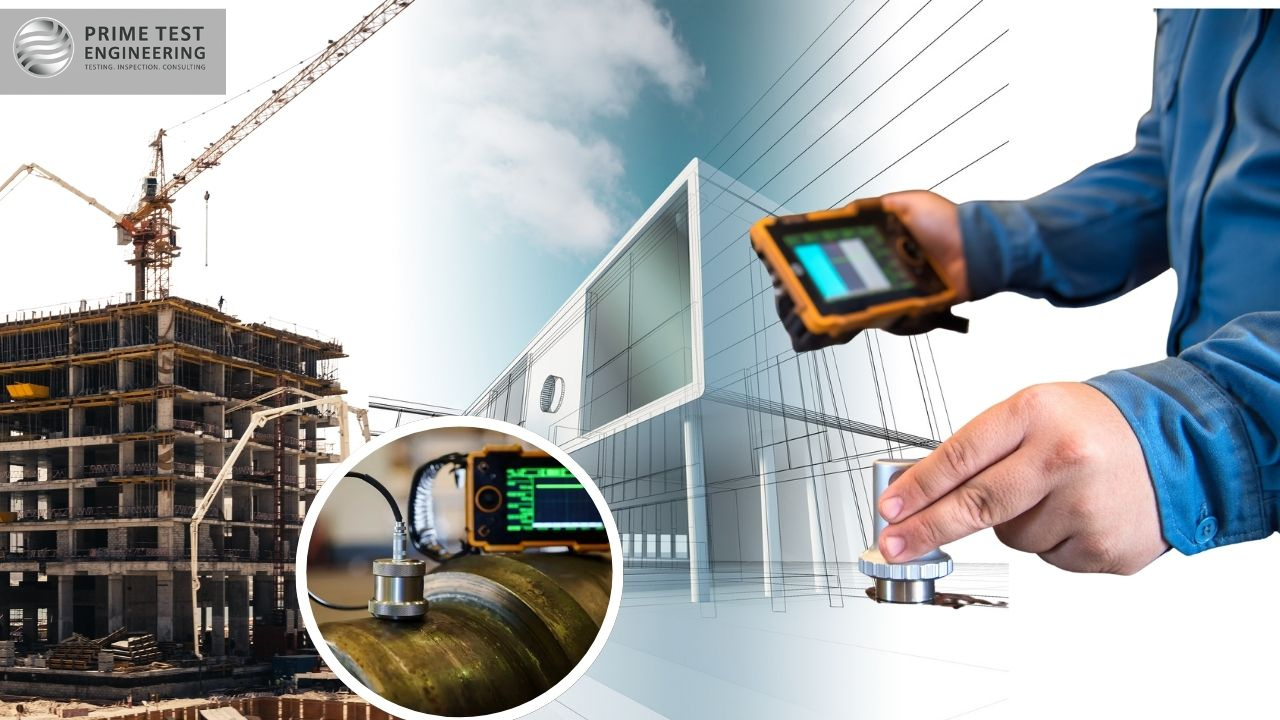
Pacing that tells cracks, inconsistency, void, and general quality of the Concrete. Book Ultrasonic Pulse Velocity Testing now for well-structured Concrete.
Guessing and visual inspection can’t tell the condition of underneath the concrete unless you break down the structure. Ultrasonic Pulse Velocity (UPV) testing gives you that answer without breaking anything open.
We run UPV testing services for structural engineers, general contractors, property owners, and public agencies who need defensible, standards-based data before they sign off on a repair plan, a purchase, or a certificate of occupancy.
The process is straightforward, but the execution matters. Take a look at typical UPV site work:
We review drawings or prior concrete crack detection testing reports if available, and identify the test grid — the specific locations and spacing needed to answer your engineering question.
Transducers need consistent contact with the concrete surface, so we prep the test points and apply a coupling gel to eliminate air gaps that would distort readings.
Readings are logged by location and compiled into a velocity map, so you can see where the concrete is performing well and where it isn't, not just get a single number for the whole structure.
We take direct, semi-direct, or indirect transmission readings depending on the element's geometry and accessibility — direct transmission gives the most accurate results, but it isn't always physically possible on a wall or slab that's only accessible from one side.
We correlate the Ultrasonic Pulse Velocity testing data against ASTM C597 quality classifications and, where a project needs it, against known concrete mix design or compressive strength data.
UPV testing involves an ultrasonic pulse being transmitted through the concrete from a transmitter on one surface to the receiver placed on the opposite side, and the travel time of the pulse is measured. Well-cured dense concrete rapidly transmits the pulse. Concrete containing voids, cracks, honeycombs, or is spalled or otherwise deteriorated slows down it.
The transit time turns into a velocity reading, measured in meters per second or feet per second, and that figure tells us something real that can’t be told by visual inspection: what is happening within the material, not just what is on the surface.
The method follows ASTM C597 testing, the standard test procedure for pulse velocity through concrete. It’s non-destructive, which means no coring, no drilling, no structural damage to the element being tested and no downtime for the structure while we work.

UPV testing shows up in a handful of recurring situations. If you’re in one of these, it’s worth a conversation:
After a seismic event, fire, or impact, UPV testing helps engineers determine whether concrete integrity has been compromised before anyone reoccupies a structure.
Buying a commercial property with an aging parking structure or an industrial building with a concrete-heavy shell? UPV Testing data gives you an objective read on concrete conditions before you're contractually locked in.
Comparing UPV readings against expected values for the mix design flags inconsistent curing, poor consolidation, or honeycombing while it's still cheap to address.
Combined with other NDT methods, Ultrasonic Pulse Velocity helps map the extent of internal cracking or voids that surface inspection alone will miss.
Running UPV testing at intervals on the same structure — a bridge deck, a parking garage, a marine structure — builds a trend line, so declining concrete quality gets caught before it becomes a safety issue.
After a structural repair or retrofit, Ultrasonic Pulse Velocity testing confirms the repaired section actually performs comparably to the surrounding sound concrete.
UPV testing offers several practical advantages. Because it doesn’t require removing a section of the structure, it leaves the concrete’s integrity fully intact, unlike core extraction, which physically damages the material being tested. It’s also captured reading directly on-site and processed without the days-long delay that lab curing and crushing add to core sampling.
Because UPV is non-invasive, more locations across a structure can be tested within the same budget, giving a fuller picture of overall condition instead of relying on a handful of isolated extraction points. And since there’s no hole to patch or repair afterward, UPV testing skips the follow-up work and reinspection that core sampling leaves behind.
But Ultrasonic Pulse Velocity Testing is a comparative and diagnostic tool, not a direct substitute for compressive strength testing in every case. For projects that require certified compressive strength values, we’ll tell you upfront if core sampling or a combination approach is the more defensible path — we’re not going to sell you the wrong test for your engineering question.

You’re not just getting a spreadsheet of numbers. Every report includes:
If a project needs the data formatted for submission to a specific agency or building department, tell us before the site visit and we’ll structure the report accordingly.
UPV testing on your property follows ASTM C597, the standard method for measuring ultrasonic pulse velocity through concrete — not an in-house or improvised process, but a procedure structural engineers across California rely on when they need results that hold up to third-party scrutiny.
The non-destructive concrete testing lets us assess a structure’s internal uniformity, locate voids and cracking before they turn into liabilities, and evaluate whether earlier repairs actually took hold — all without opening a single hole in the surface. Since the pulse velocity is related to the elastic modulus and density of concrete, instead of a visual assessment, the results can be compared with ACI 228.1R to monitor the relative strength variations in the structure, providing you with information not merely a report which is silently filed.

UPV testing correlates with concrete quality and relative strength, but it isn’t a direct measurement of compressive strength on its own. For projects requiring certified strength values, it’s often paired with core sampling or calibrated against known mix data for that structure.
It depends on the size of the structure and the number of test points needed. A single slab or wall section might take a couple of hours; a full parking structure or bridge deck assessment can take a full day or more. We’ll scope the timeline once we know the structure and the test grid.
Direct transmission (opposite faces) gives the cleanest readings, but it’s not always possible — a slab on grade, for example, is only accessible from one side. In those cases we use semi-direct or indirect transmission methods, which still produce usable data, just with different calibration considerations.
Not directly. Ultrasonic Pulse Velocity Testing is built to assess concrete density, voids, cracking, and general quality — not the condition of embedded steel. If corrosion is a concern, that typically calls for a different NDT method (like half-cell potential testing) alongside UPV.
Turnaround depends on the scope of the job and how much post-processing the data needs. Ultrasonic Pulse Velocity Testing typically takes 2-4 days, depending on how complex the test results are.
Guessing at concrete conditions is expensive in a different way than testing it — you find out the guess was wrong after the repair estimate, the lease is signed, or the inspection deadline has passed. Ultrasonic Pulse Velocity Testing gives you a defensible answer before any of that happens.
If you have a structure in California that needs an objective read on its concrete condition, reach out with the project details — element type, approximate size, and what decision the data needs to support and we’ll scope the concrete quality assessment plan from there.