

At Prime Test Engineering, we stand at the forefront of nondestructive testing (NDT) for concrete structures, offering a suite of advanced NDT services designed to safeguard the integrity and safety of your critical infrastructure. Our team of highly skilled NDT technicians, armed with certifications and deep expertise, leverages sophisticated NDT techniques to assess the condition of concrete without inflicting any harm. Utilizing state-of-the-art equipment, we specialize in Shear Wave Tomography, Impact Echo, GPR Scan (GPR), X-Ray Scan Concrete, Ultrasonic Pulse Velocity, and Schmidt Hammer tests among others, to deliver precise and insightful evaluations of your structures.
Our commitment to technological excellence and best practices ensures that we provide not only reliable results but also actionable insights. Our NDT services offer a comprehensive view into the internal health and performance of concrete structures, allowing for proactive decision-making regarding maintenance, repair, and longevity strategies. From detecting internal defects and evaluating compressive strength to assessing the extent of deterioration, our tailored NDT solutions bring clarity and confidence to the management of your assets.
Utilize non destructive testing services methods to identify and locate concealed structural issues, including voids and air pockets within concrete elements.
Conduct comprehensive assessments to detect and evaluate the integrity of cold joints and delamination, ensuring structural cohesion and durability.
Implement non destructive testing methods to assess the bonding between concrete layers, ensuring quality assurance in concrete placement and preventing potential weaknesses.
Utilize advanced nondestructive testing techniques to identify internal defects such as cracking, honeycombing, and other structural irregularities without causing damage to the concrete surface.

Provide a holistic approach to quality control, ensuring that non-destructive testing is applied to various aspects of concrete structures to detect defects, assess quality, and maintain structural integrity.
Prime Test Engineering employs cutting-edge technology tools for non-destructive testing evaluations, including Ultrasonic Pulse Velocity (UPV), Shear Wave Tomography, Impact Echo, Ground Penetrating Radar Scan (GPR), X-ray Scan Concrete, and more. These sophisticated nondestructive testing services tools ensure a high level of precision in assessing the integrity of structures non-destructively, providing detailed insights into their condition and helping to make informed decisions for maintenance and improvement.
Prime Test Engineering employs the ASTM C900 method, as recommended by ACI 228, as a primary test for non-destructive in-place concrete strength estimation. This method involves pullout testing, offering reliable data on the concrete's strength.
As a secondary test in the non-destructive strength estimation process, Prime Test Engineering non destructive testing specialists utilizes the ASTM C803/C803M method, aligned with ACI 228, for penetration resistance testing. This additional test provides supplementary insights into concrete strength.

Employing the ASTM C805/C805M standard, Prime Test Engineering non destructive testing technician uses the rebound number method for assessing the relative compressive strength of in-place concrete, contributing to a comprehensive strength estimation.
Prime Test Engineering, the best non destructive testing company employs the ASTM C597 standard for Ultrasonic Pulse Velocity (UPV) testing, an advanced non-destructive method that provides valuable information on the concrete's internal condition and compressive strength.
The professional Nondestructive testing technician of Prime Test Engineering utilizes the ACI 503.1R: BS 1881-207 standard for in-place pull-off testing, calibrated appropriately for accurate and reliable assessments of concrete strength, ensuring a thorough and well-rounded approach to non-destructive strength estimation.
The use of Impact Echo testing aids in verifying the structural integrity of repair layers. This non-destructive method assists in detecting anomalies and ensuring that the repair work meets required quality standards.
Utilizing shear Wave tomography, Prime Test Engineering assesses the subsurface conditions of repair layers. This advanced nondestructive testing services technique allows for a detailed analysis of the material's integrity, identifying any potential defects or weaknesses within the repair structure.
Prime Test Engineering employs the ASTM C1583 standard for pull-off testing to assess the bond strength of repair layers. This method provides quantitative data on the adhesion between the repair material and the existing structure, ensuring the quality of the repair work.
The advanced Nondestructive Testing Company Prime Test Engineering employs UPV testing to identify the quality of materials in repair layers. This method assists in evaluating the overall soundness and homogeneity of the repaired structure, providing insights into the effectiveness of the repair work.
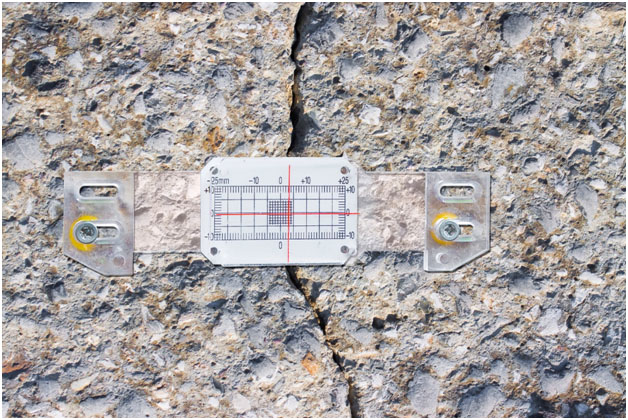
Continuously monitor changes in width and length of cracks to dynamically track their progression over time, providing valuable insights into structural integrity.
Evaluate the stability of cracks to distinguish between active and dormant states, aiding in the assessment of potential risks and necessary interventions.
Investigate the influence of external factors, such as temperature and moisture, on crack behavior to understand their impact and anticipate structural responses.
Detect and monitor any movement or displacement of cracks, allowing for early identification of potential structural issues and facilitating timely corrective measures.
Monitor crack behavior during load testing or dynamic events, offering real-time insights into how cracks respond under varying stress conditions.
Nondestructive testing (NDT) for concrete structures is a group of analysis techniques used in the science of materials evaluation without causing damage. NDT allows for the inspection and assessment of concrete’s internal condition, including the detection of cracks, voids, and other anomalies, as well as the evaluation of structural integrity and material properties.
NDT is crucial for concrete structures to ensure their safety, durability, and reliability without compromising their integrity. It helps in early detection of potential issues, assessment of structural health, and determination of repair needs, thereby extending the lifespan of structures and saving costs on extensive repairs or replacements.
Our team of certified NDT technicians & professionals is equipped with state-of-the-art NDT equipment and follows stringent industry best practices. We combine our technical expertise with a thorough understanding of concrete behavior to interpret NDT data accurately, ensuring reliable and actionable insights for our clients.
While NDT is highly effective in identifying a wide range of defects and assessing concrete quality, the detectability of certain flaws may depend on the method used and the specific conditions of the structure. Our Non Destructive Testing experts can advise on the most suitable NDT methods for your specific needs to ensure comprehensive assessment.
If NDT reveals defects or areas of concern, Prime Test Engineering will provide detailed findings along with professional recommendations for the next steps. This may include closer inspection, monitoring, or repair strategies tailored to address the identified issues and ensure the structure’s safety and longevity.