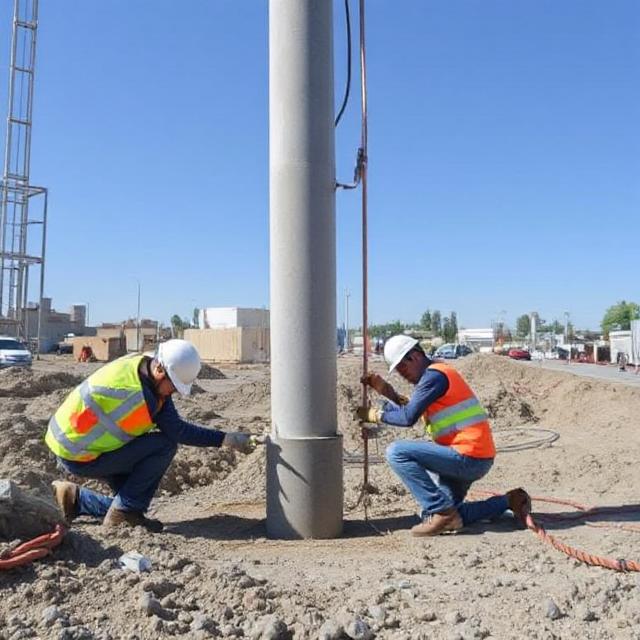


Honeycombing is a common concrete defect caused by insufficient compaction, poor workability, improper placement, or inadequate vibration. It creates voids and gaps between aggregates, reducing the uniformity and potentially affecting the durability and structural performance of concrete. Since much of honeycombing can occur below the visible surface, Ultrasonic Pulse Velocity (UPV) testing provides a useful non-destructive method for identifying suspicious areas without damaging the structure.
What Is Honeycombing in Concrete?
Honeycombing refers to areas where concrete contains interconnected voids, cavities, or poorly compacted zones. It is often visible on the surface as exposed aggregate or rough, porous concrete, but internal honeycombing may remain hidden.
Common causes include:
- Insufficient vibration during concrete placement
- Poor concrete workability
- Improper placement techniques
- Congested reinforcement
- Segregation of concrete
- Inadequate compaction
Internal honeycombing can be difficult to identify through visual inspection alone. This is where NDT methods such as UPV can provide additional information.
How Does UPV Testing Work?
UPV testing works by transmitting an ultrasonic pulse through concrete and measuring the time required for the pulse to reach a receiving transducer. Pulse velocity is calculated from the known distance and measured transit time.

In sound and relatively homogeneous concrete, ultrasonic waves can travel through a continuous concrete matrix. When the pulse encounters cracks, voids, honeycombing, or other discontinuities, its path can become longer or more complicated, and the measured velocity may decrease.
The basic relationship is:
Pulse Velocity = Path Length ÷ Transit Time
Therefore, variations in UPV readings across a concrete member can help identify areas that require further investigation.
How Does UPV Detect Honeycombing?
UPV does not detect honeycombing simply by looking for one specific velocity value. Instead, engineers generally compare measurements from different locations on the concrete member.
A test grid can be marked over the surface, and UPV readings can be taken at multiple points. Areas showing significantly different or unusually low readings compared with surrounding sound concrete may indicate internal discontinuities such as voids or honeycombing. Studies have demonstrated the effectiveness of UPV for detecting simulated honeycombing and voids in reinforced-concrete elements.
For example, if most points on a beam show relatively consistent pulse velocities but one localized area produces substantially lower or inconsistent readings, that zone may require further examination.
UPV Testing Procedure for Honeycombing Assessment
A typical assessment involves the following steps:
1. Surface Preparation:-
The concrete surface is cleaned and prepared so that the transducers can make proper contact with the concrete.
2. Test Grid Marking:-
A measurement grid is established over the area being investigated. Regular measurements help identify changes in concrete uniformity.
3. Transducer Placement:-
The transmitting and receiving transducers are positioned according to the selected testing arrangement. Direct transmission is generally preferred when access to opposite faces is available.
4. Pulse Transmission:-
The instrument sends an ultrasonic pulse through the concrete and records the transit time.
5. Velocity Calculation:-
The instrument calculates pulse velocity using the measured path length and transit time.
6. Comparison of Results:-
Readings from different locations are compared to identify areas with abnormal variations. These zones can then be mapped for further assessment.
What Do Low UPV Readings Mean?
Lower pulse velocity can be associated with voids, cracks, honeycombing, poor consolidation, or other discontinuities. However, a low reading does not automatically prove that honeycombing is present. Concrete moisture, aggregate type, reinforcement, surface condition, temperature, path length, and testing arrangement can also influence UPV results.
For this reason, UPV results should be interpreted by qualified professionals and, where necessary, supported by additional investigation.
Can UPV Determine the Severity of Honeycombing?
UPV can help identify suspicious or non-uniform zones and assess the relative condition of concrete. However, it may not precisely determine the complete size, shape, or depth of a honeycombed area using conventional transmission measurements alone.
For important structural investigations, engineers may combine UPV with other NDT or verification techniques. Research has shown that combining methods such as UPV, Ground Penetrating Radar (GPR), and Half-Cell Potential can improve damage detection in reinforced-concrete structures.
Where significant defects are suspected, additional methods such as core examination may be considered to verify the condition of the concrete.
Advantages of Using UPV for Honeycombing Detection
UPV testing offers several advantages:
- Non-destructive: Concrete remains largely undamaged during testing.
- Internal assessment: It can provide information about conditions beneath the surface.
- Rapid testing: Multiple locations can be tested during a site investigation.
- Area mapping: Readings can be taken across a grid to identify variations.
- Useful for existing structures: It can support condition assessments without extensive removal of concrete.
Conclusion
UPV testing is an effective non-destructive testing method for identifying suspicious zones associated with honeycombing, voids, cracks, and other internal discontinuities in concrete. By measuring ultrasonic pulse travel time and comparing velocity readings across a structure, engineers can identify areas of abnormal concrete uniformity.
However, UPV should be considered an assessment tool rather than a standalone confirmation of honeycombing. For critical structural decisions, the results should be interpreted with site conditions and, when necessary, supported by other NDT or confirmatory testing methods.