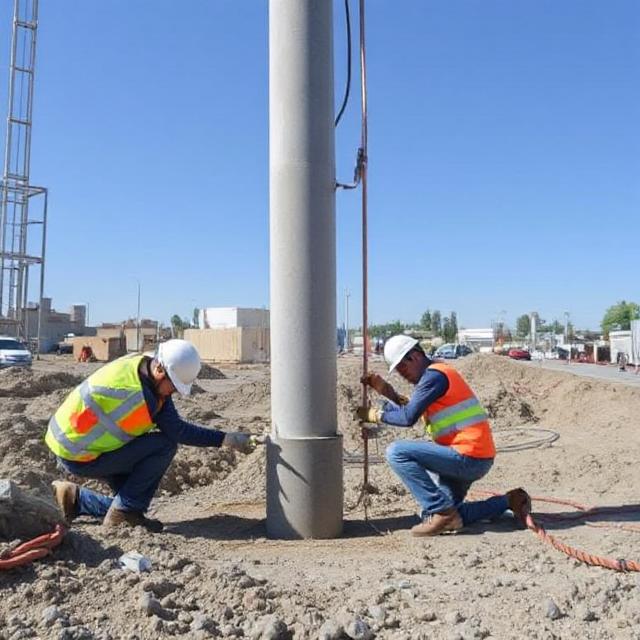



The concrete industry is the pillar of today’s construction. It’s in the buildings we work in, the bridges we drive over, and the infrastructure that links our cities. The Quality Control for Concrete in Construction Works is essential. Inadequate quality control may cause cracking, early degradation and in extreme situations collapse of structures. That’s why there is no such thing as too much quality control in cement production and application.
Concrete is the most used and essential construction material which is made by mixing cement, water and aggregates like sand and gravel. A chemical process takes place as it is mixed, hydration, and it hardens over a period of time into a strong, stone-like material. Its strength and robustness made it a necessity to build structures such as buildings, roads and bridges.
Why Quality Control for Concrete in Construction Matters
What we mean by concrete quality control is making sure that each and every cubic meter of concrete delivered to your site meets a set of closely defined specification and performance requirements. But why is that so important?
The answer is simply: durability and safety. Nonconforming concrete can cause severe problems as it ages. Shrinkage relaxation causes cracking. Poorly consolidated compaction results in voids and weak areas. Inadequate curing leads to strength loss and increased vulnerability to attack by the environment. They are not just skin-deep problems — they compromise the strength of your whole project.”
Safety aside, there’s a financial side to it. Quality Control for Concrete reduces the chance of expensive repairs and rework later on. This is for economical mix design and to reduce unnecessary cement content without compromising on strength. This also facilitates faster project completion as informed decisions for removal of formwork and for application of loads on slabs are made on the basis of concrete strength rather than on guesswork.
The Three Stages Where Quality Control for Concrete Happens
Think of Quality Control for Concrete as a play with three acts, each act having an important part in the end result.
Stage One: Pre-Pour Preparation
Not a single drop of concrete falls to the earth, the foundation must be laid. This starts with material testing. The cement, aggregates, water and admixtures used must comply with specified requirements and be obtained from recognized suppliers. Think of it like checking your ingredients before you bake a cake — you wouldn’t use expired flour or rotten eggs, right?
The concrete mixture should be amended and designed with your particular project requirements and conditions of environment in mind. The water-to-cement ratio is important here. Over-watering results in a weak, cracking concrete. Not enough and it’s difficult to work with and get in place. It’s just a question of finding that happy medium.
Weather considerations also play a role. Temperature, relative humidity and wind velocity may influence the curing. Weather extremes can tell on you, and so seasoned crews adapt.
Moreover the formwork shall be examined whether it is correctly and adequately erected to resist the weight of concrete and the shape of the element. An incorrectly fitted shutter can lead to deformities and structural issues that no amount of good concrete can repair.
Stage Two: During the Pour
When the concrete shows up on your job site, it’s your time to shine. The time from when the mix leaves the plant until it is discharged at the project site should be as short as possible otherwise setting will occur before placing the concrete.
Slump tests are carried out to verify the mix consistency complies with the specifications. This is a fast and easy test to find out how much the concrete slumps when you remove a cone-shaped form. It gives you a good sense of how workable the mixture is and if it flows through the test has the correct consistency.
When placing concrete, it’s all about technique. Incorrect placement, over-vibration or under-layering the product can result in segregation and air entrapment, producing a weak structure. This is the reason why a seasoned concrete crew is as valuable as gold- they understand how to place concrete correctly.
Stage Three: Post-Pour Monitoring
Then the real test starts: the concrete is placed and consolidated. Conditions of cure have to be monitored strictly. Excessive drying or heating may cause cracking or low strength. This is where the high tech comes in.
Historically, compressive strength testing of cylinders is accurate but time consuming. Sophisticated sensors, however, are capable of measuring the internal temperature of the concrete in real time, to guarantee the best curing conditions and to avoid thermal cracking. The same sensors continuously monitor the strength development of the concrete so engineers can make informed decisions as to when it is safe to strip formwork or apply loads.
Testing Methods: From Ancient to Modern
The most classical approach, molding concrete cylinders and crushing them in a lab after 7 or 28 days has been followed since the early 1800s. It’s accurate, but not real-time.
In the present day, engineers have a plethora of tools. The rebound hammer test may be performed on site rapidly and related measurement of hardness. The penetration resistance test (also called the pullout test) assesses the strength of concrete by pushing a small probe into the surface, taking little time for evaluation. Ultrasonic pulse velocity method is a testing technique in which pulses of vibrations are used to non-destructively determine the density and elastic properties of concrete. Drilled cores can be tested in a compression machine for a direct measurement of in situ strength. There are benefits and disadvantages for each technique, and specialist teams will often use a combination to provide the most accurate evaluation.
The test method for the cylinders is performed in two ways:
field-cured cylinders are in accordance with ASTM C31 and tested at 7, 14, and 28 days for compressive strength, while cast-in-place cylinders are cast in the real structure and then tested, leading to more realistic and accurate results since cast-in-place cylinders cure under the same conditions as the surrounding concrete.
Read more: Visual Inspection Non Destructive Testing (NDT)
Conclusion
Quality control for concrete isn’t simply a box to check on a compliance form. It’s the distinction between a building that endures for a century and one that crumbles within decades. It’s ensuring that everyone who walks in that building or drives over that bridge is safe.
with strict quality control from the early material choice all the way through final curing, building teams can have peace of mind. They can finish their work and have the peace of mind to go home at night, knowing they’ve done right by their clients, and, most importantly, the people who will live and work in those buildings.