
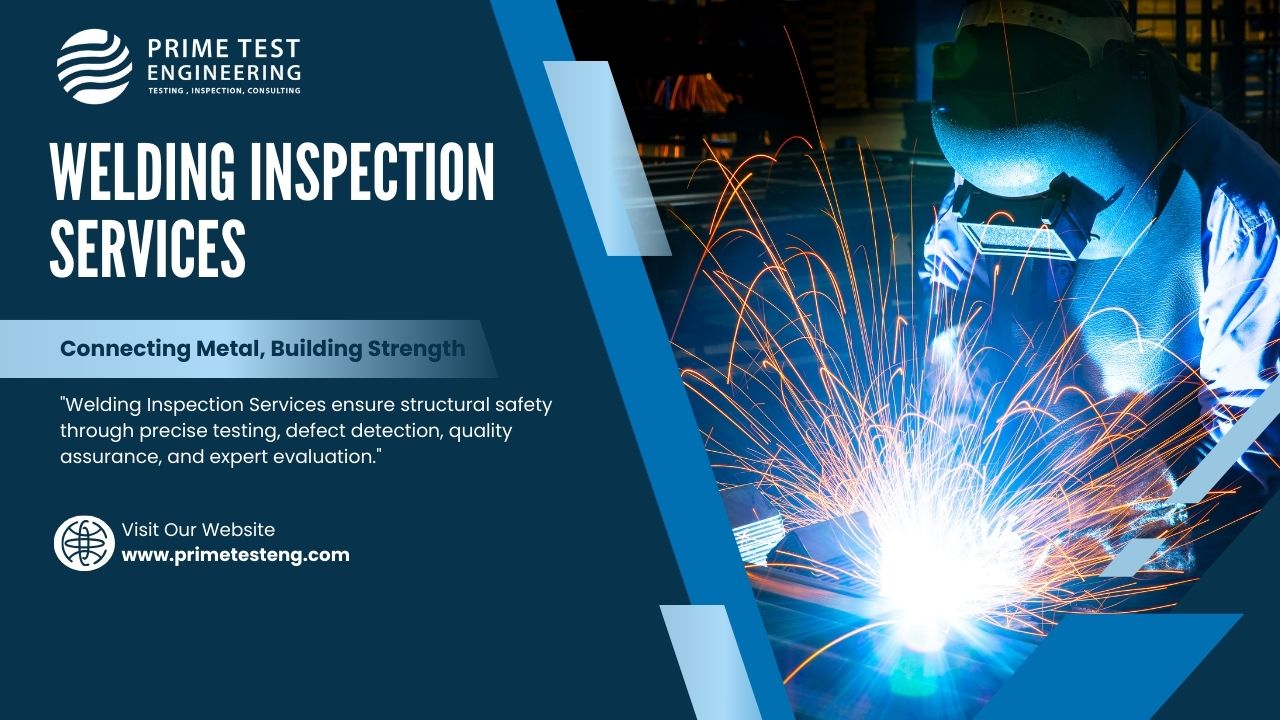
When you walk past a towering skyscraper or drive across a suspension bridge you might not stop to think that tens of thousands of welded joints are holding that structure together. But behind every full-height building and river-spanning bridge is a group of committed individuals who completed Welding Inspection Services for every property. Enter welding inspection services, which are, frankly, the unsung heroes of modern construction.
Why Should Construction Companies Care About Welding Inspection Services ?
Welding Inspection Services are the backbone of the structural soundness. When steel beams, columns, and joints are welded together as part of a construction job, the safe and long-lasting nature of the welds plays a critical role in the safety and longevity of the building as a whole. Bad welds not only ruin the appearance of a product, they can cause catastrophic failures that endanger lives and lead to costly repairs or, even more money.
Inspection of welding is a non-destructive examination and testing of a welded joint and weldment to determine that it complies with quality, safety and performance requirements. Inspectors are basically verifying that your work complies with all the codes, standards, and project specifications prior to moving on. It’s preventive medicine for your building.
What Are Inspectors Actually Looking For?
Welders are experts but even the best of welders can have problems. Typical weld defects include cracks, porosity (small holes in the weld), lack of fusion where the weld metal does not properly bond with the base metal, and lack of penetration where the weld does not sufficiently penetrate into the joint. If these faults are not caught, they compromise the strength of the whole building.
Inspection teams employ different methods to identify these issues at an early stage. Visual inspections are a matter of inspecting the weld surface for visible defects, but more thorough procedures are available that can reveal internal defects in the weld that the naked eye could ever detect, including ultrasonic testing, radiographic testing, and magnetic particle testing. It’s like having X-ray sight for welds—inspectors uncover concealed defects before they evolve into significant problems.
Quality Standards in the Construction Industry
You may be questioning how inspectors know what “good” looks like. The construction and welding industry is governed by a number of internationally accepted standards. The best known is AWS D1.1 (Structural Welding Code), which covers structural steel welding within building and bridge construction.
Then there’s ISO 3834 for general quality requirements and ASME Section IX for pressure related applications. These aren’t just some bureaucratic hurdles to be walked through on the way to getting a product to market – they are, in aggregate, decades of engineering knowledge and lessons learned from historical failures.
Inspection Process in Three Stages
Almost all construction projects are inspected at three levels or stages. Pre-welding inspection: Teams confirm that the materials, equipment, and set-up comply with specifications. Then there is inspection in the course of the welding process, as welders and inspectors watch the welding parameters, such as current, voltage, gas flow.
Lastly, postweld inspection evaluates the overall quality of the finished welds. This thorough coverage means “we identify and correct problems at every opportunity rather than finding out about them after the fact.”
Why This Is Important for Your Project’s Time and Cost
Here’s something a good many construction managers will tell you: detecting and fixing weld defects at the beginning is orders of magnitude less expensive and time-consuming than having to do it later. When a defect is detected by an inspector during construction, the welder can fix it on the spot. If the defect is identified after the structure is partially complete or in service, be prepared for costly rework, potential safety shutdowns and substantial project delays.
Moreover, the thorough inspection and documentation is protection for all. It demonstrates that quality requirements have been met, it facilitates third party audits and it fosters accountability throughout the construction process. For contractors and project owners, this documentation is invaluable when disputes arise or when inspections are necessary.
Beyond Simply Noticing Defects
Quality inspectors aren’t just pointing out defects—they’re working alongside the construction teams to sustain high levels of quality from start to finish of a project. They check that the welding processes are being executed as required, that the equipment is properly calibrated, and that all parties understand how critical it is to do a good job. This cooperative process keeps inspection from being a bottleneck and makes it a value-added step in the construction.
At Prime Test Engineering, we combine advanced tools with expert knowledge to deliver reliable concrete cutting and inspection services across the USA.
Read more: Building Inspection Services in Los Angeles
Conclusion
The welding inspectors in our Welding Inspection Services cater to on-site and off-site weld inspection requirements in compliance with the industry standards. They turn subjective personal evaluations into objective reports based on measurable data quality assurance. From a commercial high-rise to an industrial plant or a mission critical infrastructure project, welding inspections help guarantee that structural integrity isn’t left up to luck.
In building as in life, prevention is the best investment. When project owners and contractors choose to invest in professional welding inspection services, they are choosing safety, reliability, and long term structural performance. Because when all is said and done, the buildings that are built right, stay built right — and that’s a promise.