

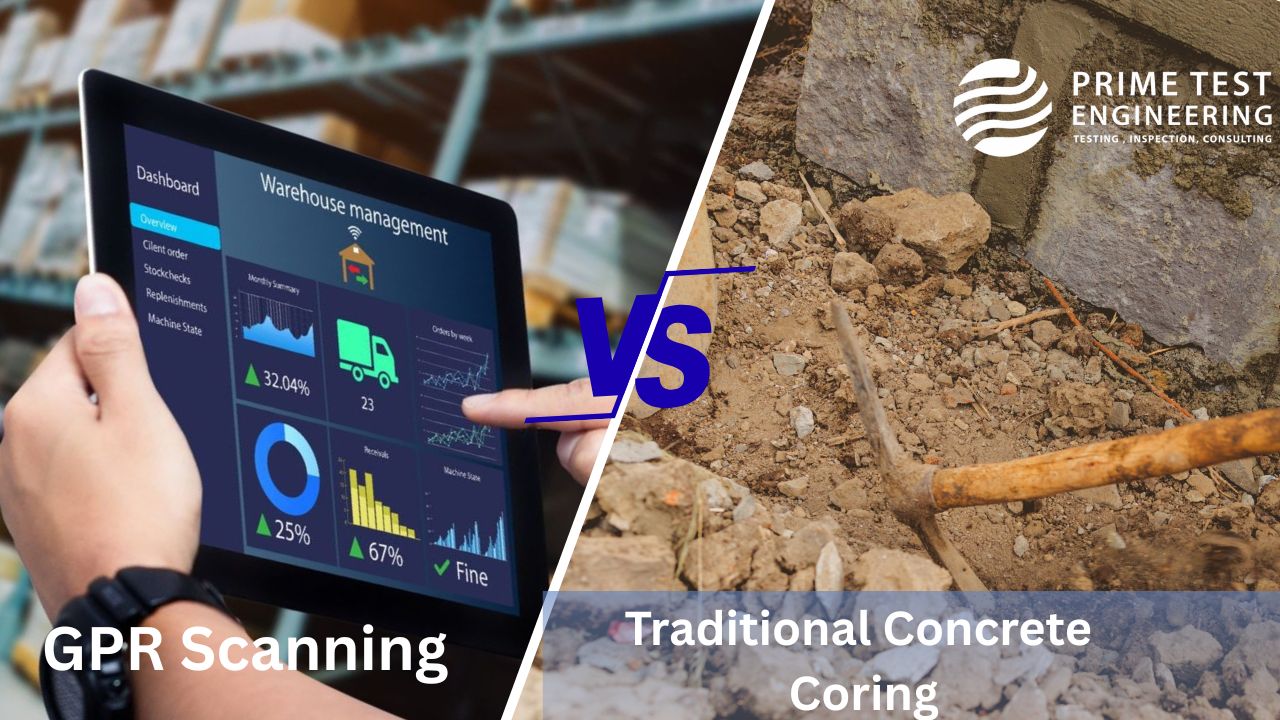
GPR Scanning vs. Traditional Concrete Coring If you have a building to maintain an apartment building, a commercial space, a warehouse, knowing your concrete is important. What follows, though, is the daily conundrum faced by property managers, engineers, and contractors: How can you find out what’s going on inside your concrete, without breaking it? This is where the discussion of GPR scanning versus traditional concrete coring comes into play and matters.
GPR Scanning Enters the Scene
Ground Penetrating Radar, or GPR, is like an X-ray for your concrete without the damage or radiation. Imagine holding a device up to your concrete slab and immediately knowing everything located below the surface – rebar, post-tension cables, voids, and damage – all as clean, detailed 3D images on your smartphone or tablet. That’s GPR scanning in a nutshell.
How Does it Work?
The technique employs signals or pulses of high-frequency radar waves, which travel through the concrete and bounce back when they encounter materials of different types or densities. These signals are transformed by advanced algorithms into user-friendly images, allowing engineers and contractors to receive actionable, real-time information. No waiting for lab results, no evacuating job sites, no worrying about radiation. Just raw, instantaneous information.
The Advantage
The true benefit here is that the GPR scanning is non-destructive. Your concrete is, for all intents and purposes, left intact after the scan. There’s no hole to patch, no structural weakness introduced by the testing. This is particularly true in older structures, where every ounce of integrity counts.
The Traditional Approach: Concrete Coring
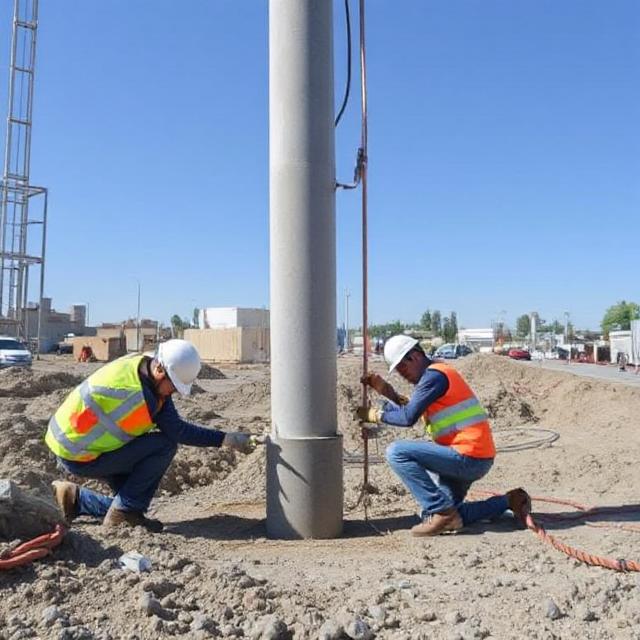
Rather, the few conventional techniques that have been in use for decades—such as coring concrete – are being evaluated to see how or whether they can be adapted to enable safe sampling. Using specialized drilling equipment, cylindrical samples are taken directly from the concrete itself. These cores are taken back to a laboratory where they are tested for density, compressive strength and whether there are any flaws in the sample.
Concrete coring is essentially semi-destructive. Yes, it yields good information on the true parameters of the concrete in-situ, but it creates a physical hole that has to be patched. A waittime is required there, too – at least five days for moisture conditioning before the cores can be tested – so you’re not going to get the kind of immediate feedback that modern construction schedules require.
But this is what makes it more time-consuming: cores must be meticulously handled, properly capped or ground and tested to the rigorous ASTM C 42 standard. When these procedures are not followed exactly, the results can be misleading and you have attacked your structure for naught.
The Real Difference GPR Scanning vs. Traditional Concrete Coring
So when you look at these two methods within the same page, the practical differences are clear. GPR Scanning vs. Traditional Concrete Coring can be conducted over large areas at a low cost in labor and yield results that can be interpreted in the field by a single technician. Conventional coring involves a team of technicians, specialized drilling equipment and lab facilities – and the waiting time for the results.
From the safety point of view, GPR is the undisputable winner. It runs silently, no special radiation shielding is required, and it does not interrupt normal functioning. You can scan in business hours without worries about evacuation. Concrete coring, on the other hand, may weaken the local structural integrity of the area being investigated and leaves a permanent cut mark on your structure.
In terms of the costs, GPR surveying is usually more cost-effective, particularly if you want to examine expansive areas or a number of different sites. When you add in the repair costs to replace cores that are removed, the financial benefit of GPR is even greater.
Bringing It All Together
Today smart building owners and engineers turn to GPR scanning as a first line of inquiry before considering if concrete coring is even warranted. GPR can rapidly detect problem areas such as voids, corrosion, cracks, and other structural anomalies allowing a targeted coring only where it is really needed. The hybrid technique preserves time, money, and the structural integrity of the balcony, while delivering broad data to support both concentrated balcony assessments as well as full-structure evaluations.
Outside its proper context, at least some of them are acid tests that confirm your knowledge. Or accidents, and sanitation (and traffic). For the long-term health of your building, knowing what these tools are and how to use them properly isn’t just know-how—it’s a stake in safety, functionality, and peace of mind.
Read more: Welding Inspection Services in Construction
Conclusion
GPR scanning and traditional concrete coring are both useful but GPR is the more intelligent first step. It is high speed, non-destructive, cost effective and is excellent for detecting hidden problems without damaging the object. Coring is necessary only in the case when precise information about the material is required, but it is intrusive, expensive and more time-consuming.
By beginning with GPR and coring only as needed, you gain time, preserve your structure, and get reliable data for both focused balcony inspections and whole building evaluations – ensuring long-term security and peace of mind.