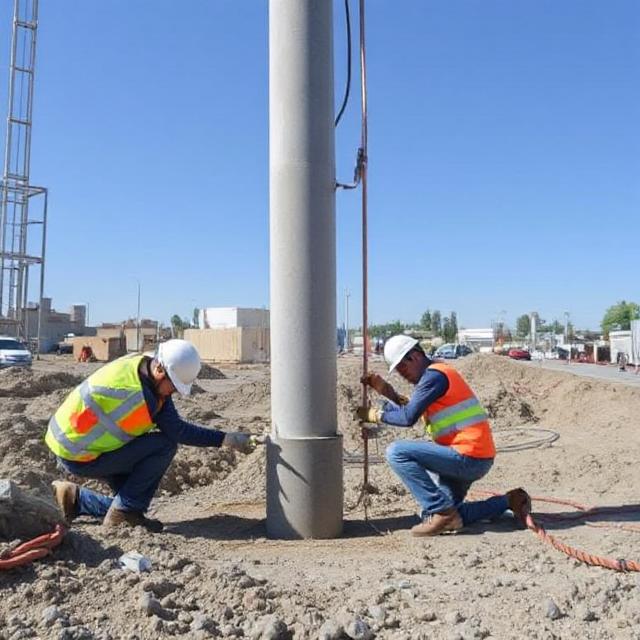


Reinforcing steel corrosion is one of the leading causes of deterioration in reinforcedconcrete structures. As corrosion progresses, steel expands, creating internal pressurethat causes cracking, delamination, and concrete spalling. Half-Cell Potential Testing isone of the most widely used non-destructive testing (NDT) methods for evaluating thelikelihood of active corrosion before significant structural damage becomes visible. AtPrime Test Engineering, we perform Half-Cell Potential Testing throughout California tohelp engineers, property owners, and facility managers assess corrosion risk and makeinformed maintenance decisions.
Introduction
Corrosion often develops long before cracks or spalls appear on the concrete surface.Chlorides, carbonation, moisture, and oxygen can break down the protectiveenvironment surrounding reinforcing steel, initiating corrosion beneath the concrete.
Half-Cell Potential Testing provides engineers with a reliable method for identifying areaswhere reinforcing steel is likely experiencing active corrosion without damaging thestructure. When combined with other investigative methods, it helps prioritize repairsand evaluate the overall condition of reinforced concrete.
Typical applications include:
- Parking structures
- Bridges
- Podium decks
- Balconies
- Commercial buildings
- Water treatment facilities
- Marine structures
- Industrial facilities
What Is Half-Cell Potential Testing?
Half-Cell Potential Testing is a non-destructive electrochemical method used toestimate the probability of active corrosion in reinforcing steel embedded withinconcrete.
The test measures the electrical potential difference between embeddedreinforcing steel and a portable reference electrode placed on the concretesurface.
These measurements are collected across a grid pattern and used to developcorrosion potential maps that identify areas with a higher likelihood of activecorrosion.
The testing procedure follows ASTM C876 – Standard Test Method for CorrosionPotentials of Uncoated Reinforcing Steel in Concrete.
Unlike visual inspections, Half-Cell Potential Testing identifies corrosion activitythat may still be concealed beneath an intact concrete surface.
Half-Cell Potential Testing Process
The testing process is straightforward but requires proper preparation andengineering interpretation.
 Step 1 – Locate Reinforcing Steel
Ground Penetrating Radar (GPR) or existing construction drawingsare often used to locate reinforcing steel and identify suitable testing locations.
 Step 2 – Establish Electrical Connection
A direct electrical connection is made to the reinforcing steel.
 Step 3 – Collect Potential Measurements
Measurements are taken over a predefined grid across the concrete surface using a reference electrode.
 Step 4 – Develop Corrosion Maps
The measured electrical potentials are plotted to create contour maps showing variations in corrosion potential across the structure.
Step 5 – Engineering Evaluation
Engineers evaluate corrosion patterns together with visual observations, structural conditions, and additional testing results to determine repair priorities.
What Can Half-Cell Potential Testing Detect?
Half-Cell Potential Testing helps identify areas where reinforcing steel is likely undergoing active corrosion.
It can help detect:
- Areas with a high probability of active steel corrosion
- Localized corrosion zones
- Corrosion progression across a structure
- Areas requiring additional investigation
- Regions suitable for concrete coring or laboratory testing
- Deterioration before visible cracking or spalling develops
It is important to understand that Half-Cell Potential Testing estimates the probability of corrosion activity. It does not measure corrosion rate or quantify steel section loss.
Benefits of Half-Cell Potential Testing
Half-Cell Potential Testing offers several advantages for evaluating reinforced concrete structures.
Key benefits are:
- Non-destructive evaluation
- Early detection of corrosion activity
- Large-area coverage
- Supports maintenance planning
- Reduces unnecessary demolition
- Identifies priority repair areas
- Helps optimize repair budgets
- Complements other NDT methods
The test is particularly valuable for aging structures where corrosion may be widespread but not yet visible.
When Should Half-Cell Potential Testing Be Performed?
Half-Cell Potential Testing is commonly recommended when corrosion is suspected or when engineers need to assess the condition of reinforced concrete before repairs.
Typical situations include:
- Parking garage investigations
- Bridge inspections
- Coastal buildings exposed to chlorides
- Waterproofing failures
- Concrete spalling investigations
- Seismic rehabilitation projects
- Building condition assessments
- Asset management programs
- Pre-purchase property evaluations
Structures near the ocean or exposed to deicing salts are especially susceptible to reinforcing steel corrosion.
Combining Half-Cell Potential Testing with Other NDT Methods
No single test provides a complete understanding of concrete deterioration.
For the most reliable evaluation, Half-Cell Potential Testing is often combined with:
- Ground Penetrating Radar (GPR) to locate reinforcing steel and measure concrete cover
- Ultrasonic Pulse Velocity (UPV) to evaluate concrete quality
- Chain Drag Surveys to identify delamination
- Concrete Coring for laboratory testing
- Chloride Ion Testing
- Carbonation Testing
- Petrographic Analysis
- Visual Condition Assessments
Using multiple testing methods provides engineers with a more comprehensive understanding of structural conditions and helps develop effective repair strategies.
How Prime Test Engineering Can Help
Prime Test Engineering provides comprehensive corrosion investigations and Non-Destructive Testing services for reinforced concrete structures throughout California.
Our corrosion evaluation services include:
- Half-Cell Potential Testing (ASTM C876)
- Ground Penetrating Radar (GPR)
- Ultrasonic Pulse Velocity (UPV)
- Chain Drag Surveys
- Concrete Coring
- Chloride Ion Testing
- Carbonation Testing
- Petrographic Analysis
- Structural Condition Assessments
- Engineering Reports and Repair Recommendations
Our experienced engineering team combines field investigations, laboratory testing, and engineering analysis to help clients understand structural deterioration and prioritize repairs.
Conclusion
Half-Cell Potential Testing is one of the most effective non-destructive methods for identifying active reinforcing steel corrosion before significant concrete damage becomes visible. By locating areas with a high probability of corrosion, engineers can investigate deterioration more efficiently, prioritize repairs, and extend the service life of reinforced concrete structures.
When combined with complementary NDT methods and laboratory testing, Half-Cell Potential Testing provides valuable information for structural evaluations, repair design, and long-term asset management.
If you suspect corrosion in a parking structure, bridge, commercial building, or other reinforced concrete structure, Prime Test Engineering can help.
Contact Prime Test Engineering today to schedule a Half-Cell Potential Testing investigation anywhere in California.
👉 Visit: https://primetesteng.com/