

The ASTM F1869 calcium chloride test helps engineers and flooring teams find out whether a concrete slab is releasing too much moisture vapor for a new flooring cover. A slab can look dry on the surface while still pushing moisture upward. Once a floor, adhesive, or coating seals that surface, the moisture can cause bubbling, cupping, debonding, or blistering.
At Prime Test Engineering, we perform concrete moisture vapor emission testing to measure that moisture before installation, when the fix is still simple. The results help owners, contractors, and flooring consultants choose the right product or decide whether a moisture-mitigation system is needed. No single test can predict every future moisture condition, but F1869 gives a clear, measurable starting point.

What Is the ASTM F1869 Calcium Chloride Test?
ASTM F1869 is the standard test method for measuring the moisture vapor emission rate (MVER) of a concrete subfloor using anhydrous calcium chloride. In simple terms, it measures how much water vapor comes out of a small, sealed area of bare concrete over a set period.
The result is reported in pounds of water per 1,000 square feet per 24 hours (lb/1,000 ft²/24 hr). Flooring, adhesive, and coating manufacturers often state their moisture limits in these units, which makes the test easy to compare against product requirements.
Why Does Concrete Moisture Matter Before Flooring?
Concrete holds water from its original mix and can also draw moisture up from the soil beneath it. When a floor covering traps that moisture, problems can include:
- Adhesive failure: glue softens or loses bond, and tiles or planks lift.
- Bubbling and blistering: vinyl sheet goods and coatings can bubble or blister.
- Wood flooring damage: boards may cup, swell, or buckle.
- Odor and mold growth: trapped moisture under a covering can lead to musty odors and microbial growth.
Warning Signs That Testing May Be Needed
Signs that may warrant moisture testing include white powdery deposits on the slab (often efflorescence), dark or damp-looking areas, failing floor adhesive, lifting tiles, or a slab below grade, such as a basement. Some slabs show no visible signs at all.
These signs do not prove that a slab is too wet, and a dry-looking slab is not proof that it is ready. Testing gives a measured answer.
How Does the Calcium Chloride Test Work?
The test follows a simple sequence, but each step affects accuracy:
- Condition the space. The area should be at normal service temperature and humidity, or 75 ± 10 °F and 50 ± 10% relative humidity, for at least 48 hours before and during testing.
- Prepare the surface. Sealers, coatings, adhesives, and curing compounds are removed at each test spot so the kit sits on bare concrete.
- Place the dish. A pre-weighed dish of anhydrous calcium chloride is set on the prepared surface.
- Seal the dome. A clear plastic dome is sealed to the concrete over the dish, then labeled with its test number and start time.
- Wait 60 to 72 hours. The calcium chloride absorbs the moisture vapor emitted beneath the dome.
- Reweigh and calculate. The dish is resealed and weighed, and the weight gain is converted to MVER.

How Is MVER Calculated?
For the standard test kits we use, the calculation is:
MVER (lb/1,000 ft²/24 hr) = Weight gain (g) × 118.932 ÷ Exposure time (hr)
How Many Tests Are Needed?
ASTM F1869 calls for at least three tests for areas up to 1,000 square feet, plus one more test for each additional 1,000 square feet or part of it.
Call Us: (310) 205-2535 Get a Quote
Real Project Example: Testing a Commercial Basement Slab
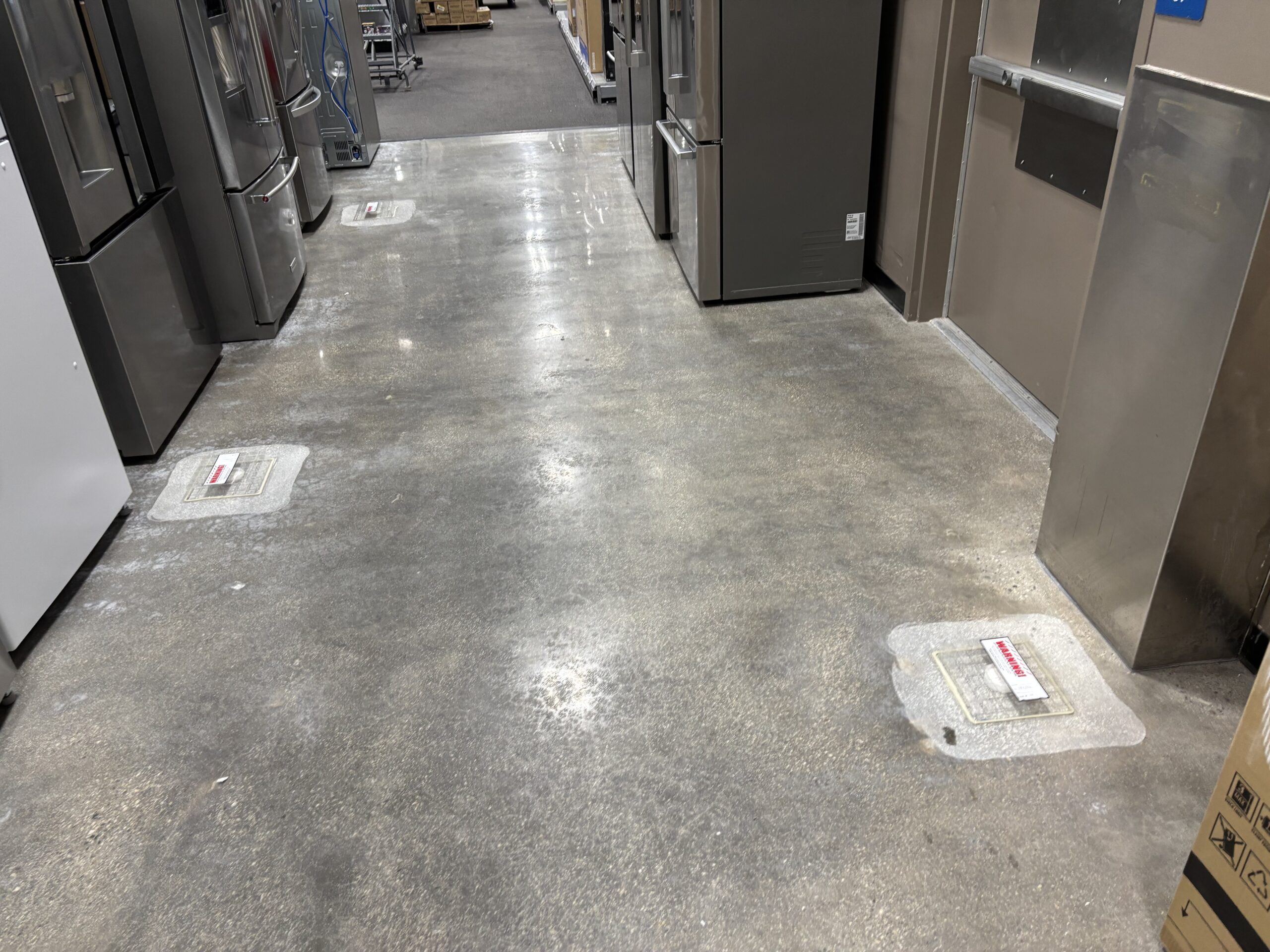
On a recent project in the Los Angeles area, a property owner asked Prime Test Engineering to evaluate moisture vapor emission from the basement slab of an occupied retail space. Earlier photos of the floor showed white surface deposits consistent with efflorescence, along with localized cracking and discoloration.
- Test area: about 120 square feet, identified by the owner as the area of concern.
- Number of tests: five kits, two more than the ASTM minimum for an area this size.
- Surface preparation: the clear sealer was removed at each test spot before installation.
- Exposure time: 70.4 to 70.8 hours, within the required 60-to-72-hour window.
- Conditions: the space was enclosed and air-conditioned throughout the test.
What Were the Results?
| Test location | Weight gain (g) | Exposure time (hr) | MVER (lb/1,000 ft²/24 hr) |
|---|---|---|---|
| T-1 | 2.7 | 70.80 | 4.5 |
| T-2 | 2.2 | 70.67 | 3.7 |
| T-3 | 2.7 | 70.39 | 4.6 |
| T-4 | 2.5 | 70.70 | 4.2 |
| T-5 | 2.6 | 70.84 | 4.4 |
| Average | 2.5 | 70.68 | 4.3 |
The readings ranged from 3.7 to 4.6 lb/1,000 ft²/24 hr, with an average of 4.3. The five locations agreed closely, which suggests the result reflects the test area as a whole rather than one isolated wet spot.
What Do the Test Results Mean?
ASTM F1869 does not set a universal pass or fail limit. The allowable MVER depends on the flooring, adhesive, coating, or moisture-mitigation system being installed, and the manufacturer’s written requirements control.
For reference, limits of 3 lb/1,000 ft²/24 hr and 5 lb/1,000 ft²/24 hr are commonly found in flooring specifications. In the project above, every reading was above 3 and below 5:
- A product rated to 5 lb would likely be acceptable, subject to the manufacturer’s full requirements.
- A product rated to 3 lb would need a more moisture-tolerant alternative or a moisture-mitigation system first.
Who Decides the Next Step?
Our role is to measure and report the slab’s moisture condition. The project’s waterproofing, coating, or flooring consultant then reviews the results and selects the appropriate system.
Call Us: (310) 205-2535 Get a Quote
ASTM F1869 vs. ASTM F2170: Which Moisture Test Is Right?
| Method | What it measures | Key limitation |
|---|---|---|
| ASTM F1869 (calcium chloride) | Moisture vapor emitted from the slab surface, in lb/1,000 ft²/24 hr | Mainly reflects conditions near the surface; sensitive to site temperature and humidity |
| ASTM F2170 (in-situ relative humidity) | Relative humidity inside the slab, using probes placed in drilled holes | Requires drilling small holes and an equilibration period before readings |
When Should Both Tests Be Used?
Many flooring manufacturers now specify ASTM F2170, either instead of or alongside F1869. For moisture-sensitive or high-value installations, running both tests can give a fuller picture of surface emission and internal slab moisture. Always check which test the selected product requires.
Concrete Moisture Testing at Prime Test Engineering
Prime Test Engineering provides concrete moisture testing and materials testing services throughout Southern California. Depending on the project, our work may include ASTM F1869 calcium chloride testing, test location planning, documentation of site conditions, and a report reviewed and signed by a licensed professional engineer.
Learn more about our concrete testing services and construction material testing. You can also read our related posts on how to test concrete moisture and why moisture testing matters before flooring installation.
Frequently Asked Questions
How long does an ASTM F1869 test take?
The kits stay on the slab for 60 to 72 hours. The space should also be conditioned for at least 48 hours before testing begins.
What is an acceptable MVER for concrete?
There is no single acceptable number. Many products allow 3 or 5 lb/1,000 ft²/24 hr, but the manufacturer’s written limit controls.
Does the sealer need to be removed before testing?
Yes. The test must be performed on bare concrete, so sealers, coatings, and adhesives are removed at each test spot first.
Can the calcium chloride test be done in an occupied building?
Yes. Testing is often performed in occupied commercial spaces, as long as the kits can stay undisturbed and the space stays near normal service conditions.
What causes white deposits on a concrete floor?
They are often efflorescence, salts carried to the surface by moisture and left behind when the water evaporates. They are a reason to consider testing, not proof of a moisture problem.
What happens if the slab exceeds the flooring limit?
Options may include a more moisture-tolerant product, a moisture-mitigation system, or additional drying time followed by retesting.
Conclusion
Moisture problems in concrete slabs are often invisible until a new floor starts to fail. The ASTM F1869 calcium chloride test measures how much moisture vapor a slab releases, giving flooring teams a clear number to compare against product requirements. As our recent project shows, a slab can fall between common limits, so the right decision depends on the specific product being installed.
Contact Prime Test Engineering to schedule concrete moisture testing before your next flooring or coating installation.
Call Us: (310) 205-2535 Get a Quote