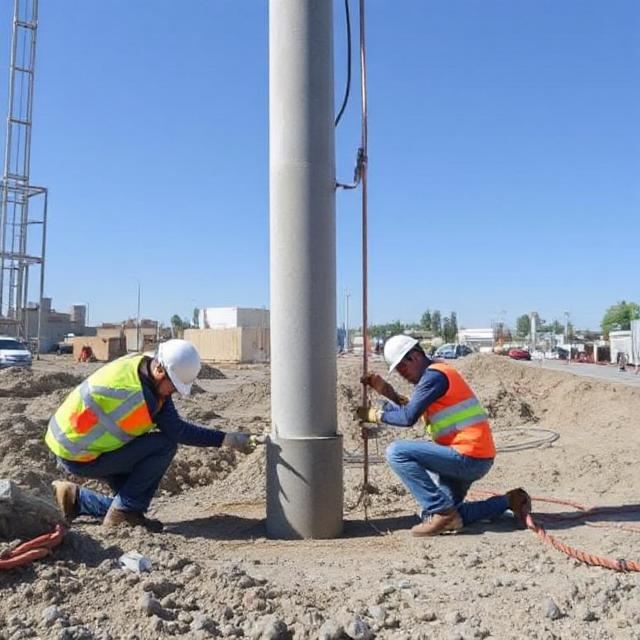

Concrete slab void detection helps engineers investigate possible gaps beneath slabs-on-grade when settlement, erosion, or cracking raises questions about subgrade support. A concrete slab may appear intact even when some of the soil or base material supporting it has moved or been lost. Related investigations may also examine voids or discontinuities within the concrete itself.
At Prime Test Engineering, non-destructive testing methods such as ground penetrating radar (GPR) and MIRA ultrasonic pulse tomography provide complementary information. GPR can help screen for subsurface interfaces and anomalies that may indicate a loss of support beneath a slab, while MIRA uses ultrasonic stress waves to investigate internal features and possible defects within concrete. Depending on site conditions, these techniques can help document potentially affected areas and guide carefully selected verification locations. Neither method can guarantee detection or confirmation of every void.
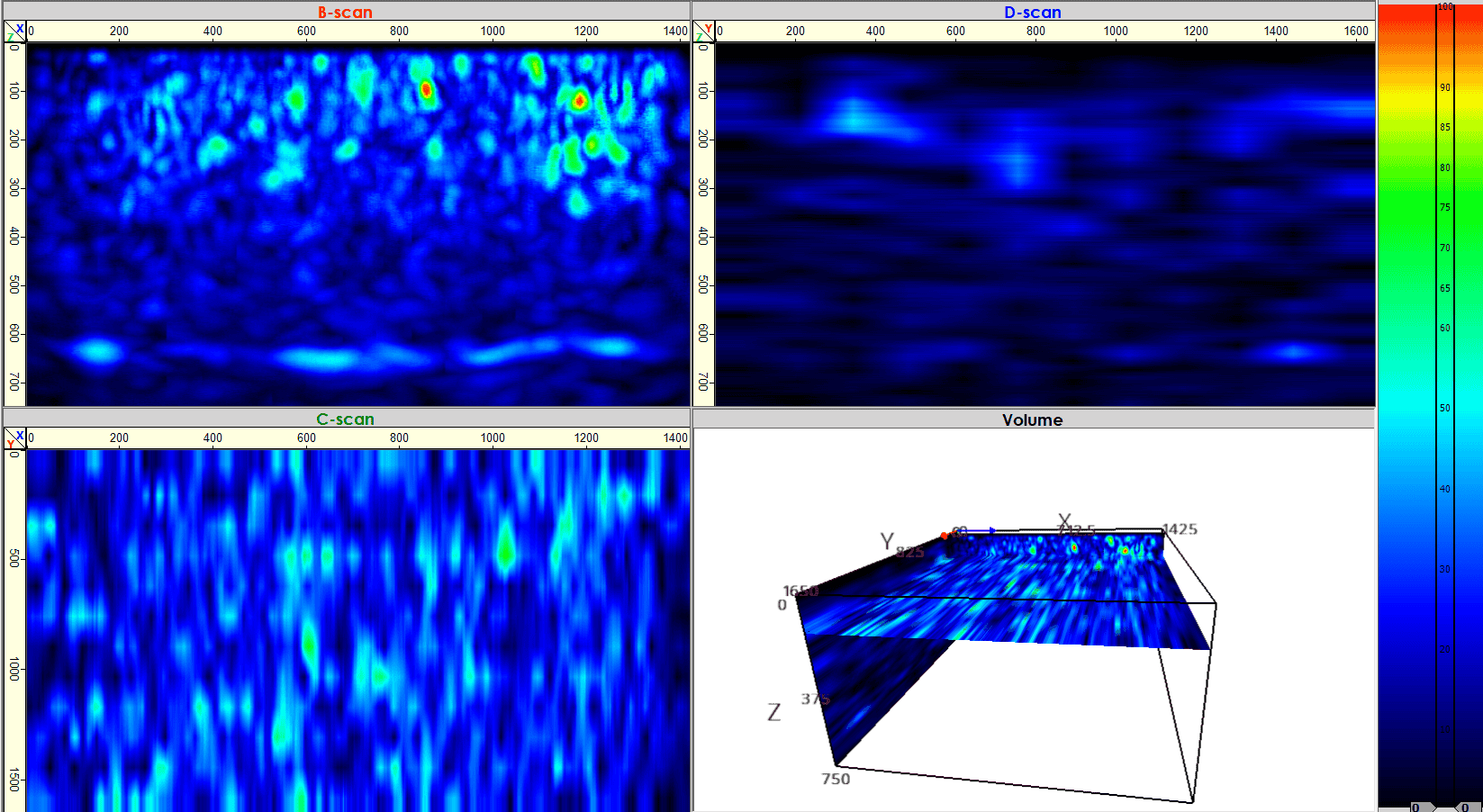
Can MIRA Ultrasonic Pulse Tomography Help Investigate Concrete Voids?
MIRA ultrasonic pulse tomography uses an array of ultrasonic transducers to send and receive mechanical stress waves, allowing engineers to reconstruct indications of internal reflecting features in concrete. Depending on the element thickness, configuration, surface access, and concrete conditions, MIRA can help evaluate internal anomalies such as suspected voids or discontinuities, as well as concrete thickness.
For a slab-on-grade, it is important to distinguish voids within the concrete from gaps beneath the slab. MIRA is primarily a tool for investigating the concrete element itself. Its results should not automatically be interpreted as proof of missing subgrade support. GPR, targeted verification, or other suitable investigations may be needed to evaluate possible subslab voids.
What Causes Voids Beneath Concrete Slabs?
A subslab void is a gap between concrete and the soil, aggregate base, or other material intended to support it. These gaps can develop through several processes:
- Erosion: flowing water carries fine soil particles away from beneath the slab.
- Inadequate compaction: poorly compacted fill consolidates after construction.
- Settlement: compressible soil or changing moisture conditions cause the supporting surface to move downward.
- Underground leaks: leaking pipes or drainage systems wash away supporting material.
- Fill changes: some fills degrade, migrate, or change volume under site-specific conditions.
Understanding the cause matters. Filling a suspected gap without addressing continuing water movement or settlement may not solve the underlying problem.
Warning Signs of Possible Voids Beneath Concrete
Signs that may warrant investigation include localized settlement, uneven floor elevations, repeated cracking, gaps near slab joints, distress around underground utilities, water intrusion, or unexpected slab movement. Some voids have no obvious surface symptoms.
These warning signs are not proof of a void. Cracks and movement can also result from shrinkage, temperature effects, loading, or other causes.
How Does GPR Detect Voids Beneath Concrete Slabs?
Ground penetrating radar (GPR) transmits electromagnetic pulses into concrete and surrounding materials. Reflections occur where the signal encounters changes in electromagnetic properties. An interface involving concrete, soil, moisture, or air may create a detectable radar response.
Technicians collect scan lines across the area of interest and examine the recorded data for unexpected reflections, changes in signal pattern, or other anomalies. Interpretation must consider the slab’s reinforcement, thickness, moisture conditions, and the materials beneath it.

Can GPR Confirm a Void?
Not always. A reflection consistent with a potential air gap may also arise from a material interface, moisture contrast, buried object, or another condition. Small or deep voids may be difficult to detect, especially beneath conductive materials or dense reinforcement.
GPR is therefore a valuable screening and mapping method, but important findings may require targeted verification.
Call Us: (310) 205-2535 Get a Quote
Can 3D GPR Map the Extent of a Potential Void?
For a larger investigation, technicians can collect radar measurements along multiple parallel or intersecting lines. Processing may produce depth slices, plan-view maps, or three-dimensional representations that help compare anomalies across a slab.

These data products are not literal photographs of the ground beneath the slab. An anomaly’s displayed outline does not necessarily equal the exact dimensions of a void. Site-specific calibration and verification may be needed.
GPR vs. Impact Echo and Other Investigation Methods
| Method | Potential use | Key limitation |
|---|---|---|
| GPR | Screen for subsurface interfaces and anomalies | An anomalous reflection is not definitive proof of an air gap |
| Impact echo | Evaluate thickness and internal concrete reflectors | Not generally a direct or definitive method for soil void mapping |
| Hammer sounding | Identify abnormal acoustic response at accessible surfaces | Does not establish subslab void geometry or cause |
| Deflection or load testing | Assess slab behavior under controlled loading | Requires engineering design and interpretation |
| Exploratory drilling/openings | Directly check selected subsurface conditions | Intrusive and localized |
What Role Does Impact Echo Play?
Impact echo produces mechanical stress waves by striking the concrete surface. It is commonly used to evaluate concrete thickness and internal reflecting interfaces under appropriate conditions. Its response may be affected by support conditions, but conventional impact echo should not be presented as reliably identifying all soil voids below slabs.

How Do Engineers Verify Suspected Voids?
Where a GPR anomaly may affect a repair decision or structural assessment, engineers may recommend a localized verification program. Possible techniques include small-diameter exploratory holes, borescope observations through suitable access points, limited slab openings, or additional geotechnical investigation.
Exploratory locations must be selected with appropriate consideration for reinforcing steel, post-tensioning, embedded utilities, access, and structural safety. Direct evidence at a few test points does not establish conditions everywhere beneath a large slab.
Why Is Loss of Subgrade Support Important?
A slab-on-grade may depend on continuous or distributed support from the underlying soil or base. If support is lost, parts of the slab can bridge across a gap and experience increased bending and cracking. The significance depends on slab thickness, reinforcement, loading, void geometry, and surrounding support.
Potential applications for investigations include warehouse and industrial floors, commercial slabs-on-grade, concrete pavement, parking areas, loading zones, and slabs near leaking underground utilities.
What Happens After a Void Is Found?
The next step is to assess the void’s location, likely cause, extent, and possible structural consequences. Depending on the findings, engineering recommendations may include drainage or utility repairs, monitoring, additional assessment, engineered void filling or grouting, subgrade stabilization, or slab reconstruction.
No repair should be selected solely from a radar image without considering the overall structure and site conditions.
Call Us: (310) 205-2535 Get a Quote
Concrete Slab Void Detection at Prime Test Engineering
Prime Test Engineering provides non-destructive testing and structural condition assessment services throughout Southern California. Depending on the project, an investigation may include visual observations, GPR scanning, grid-based surveys, anomaly mapping, concrete thickness and reinforcement assessment, and recommendations for targeted verification.
Learn more about our GPR scanning services and concrete coring services.
Frequently Asked Questions
Can GPR detect air gaps beneath concrete slabs?
It may detect reflections associated with air gaps under favorable conditions. Detection depends on gap dimensions, depth, slab reinforcement, and soil properties.
Can GPR determine the exact size of a void?
Not necessarily. GPR may help map a suspicious zone, but verification is often needed before identifying void boundaries.
Can a void exist beneath a slab without visible cracks?
Yes. Some areas of lost support do not produce immediate visible distress.
Is GPR destructive?
No. GPR scanning is generally non-destructive and does not require opening the concrete.
Is honeycombing the same as a subslab void?
No. Honeycombing is a defect within the concrete; a subslab void is a gap between concrete and its intended supporting material.
Does detecting a void mean the slab must be replaced?
No. The appropriate response depends on structural significance, cause, size, loading, and feasibility of repair.
Conclusion
Voids beneath concrete slabs may develop through erosion, settlement, inadequate compaction, or utility leaks. Concrete slab void detection with GPR can help identify possible subsurface anomalies and target additional investigation without widespread removal of concrete. Radar findings require careful interpretation, and important anomalies may need direct verification.
Contact Prime Test Engineering to discuss an appropriate testing approach for suspected slab settlement or loss of support.
Call Us: (310) 205-2535 Get a Quote