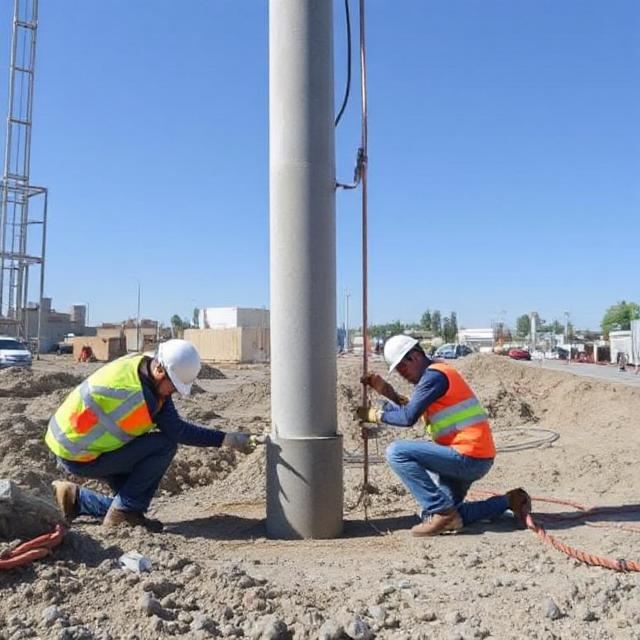


The half-cell potential test measures the electrical potential of the steel inside reinforced concrete to show where the rebar is likely to be corroding. It answers a question every owner and engineer faces before repairs: where is corrosion active right now, even where the concrete still looks sound?
At Prime Test Engineering, we perform the half-cell potential test under ASTM C876 on parking structures, podium slabs, balconies, beams, columns, bridges and marine structures. Corrosion starts long before cracks and spalls appear. A survey done before the damage shows lets owners plan repairs on their own schedule instead of reacting to falling concrete.
What Causes Rebar Corrosion in Concrete?
Steel in healthy concrete is protected by a thin passive film. The high pH of the concrete, around 12.5 to 13, keeps that film stable. As long as the film holds, the steel does not rust, even when the concrete is wet.
Two things break the film down:
- Chlorides: salt from seawater, salt air, deicing salt or old calcium chloride admixtures moves through the concrete. Once enough chloride reaches the steel, the film breaks down in spots and corrosion starts.
- Carbonation: carbon dioxide from the air reacts with the concrete and lowers its pH. When the carbonated zone reaches the depth of the bars, the steel loses its protection.
Water and oxygen then feed the reaction. Cracks, thin cover, poor drainage and failed coatings let them in faster. Our post on what causes rebar corrosion in concrete covers these causes in more depth.
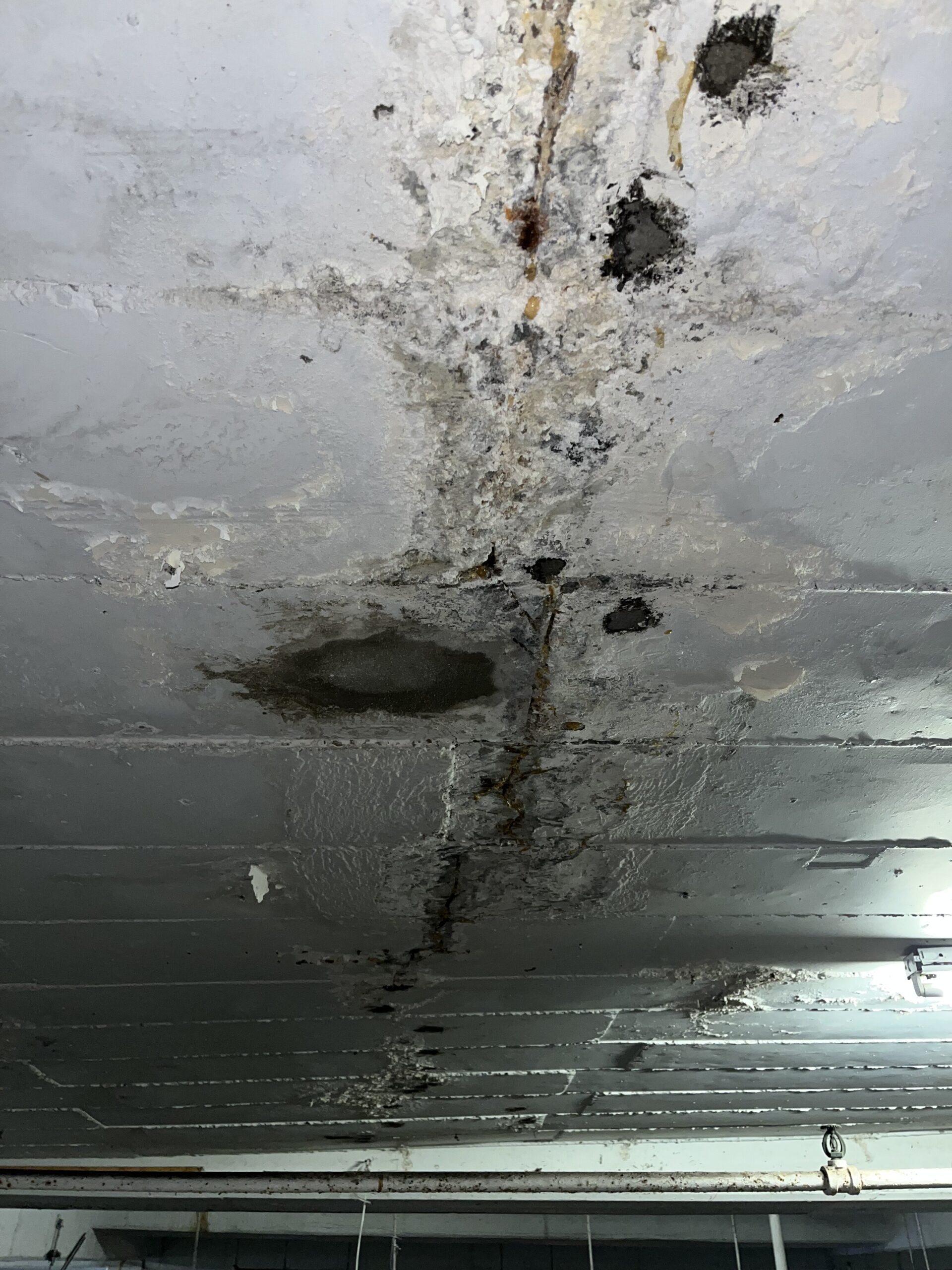
Rust takes up several times the volume of the steel it replaces. As it builds up around the bar, it pushes on the concrete from the inside. The first signs are rust stains and fine cracks that run along the line of the bars. Later, the cover delaminates and breaks off, leaving the steel exposed, as in the photos here.
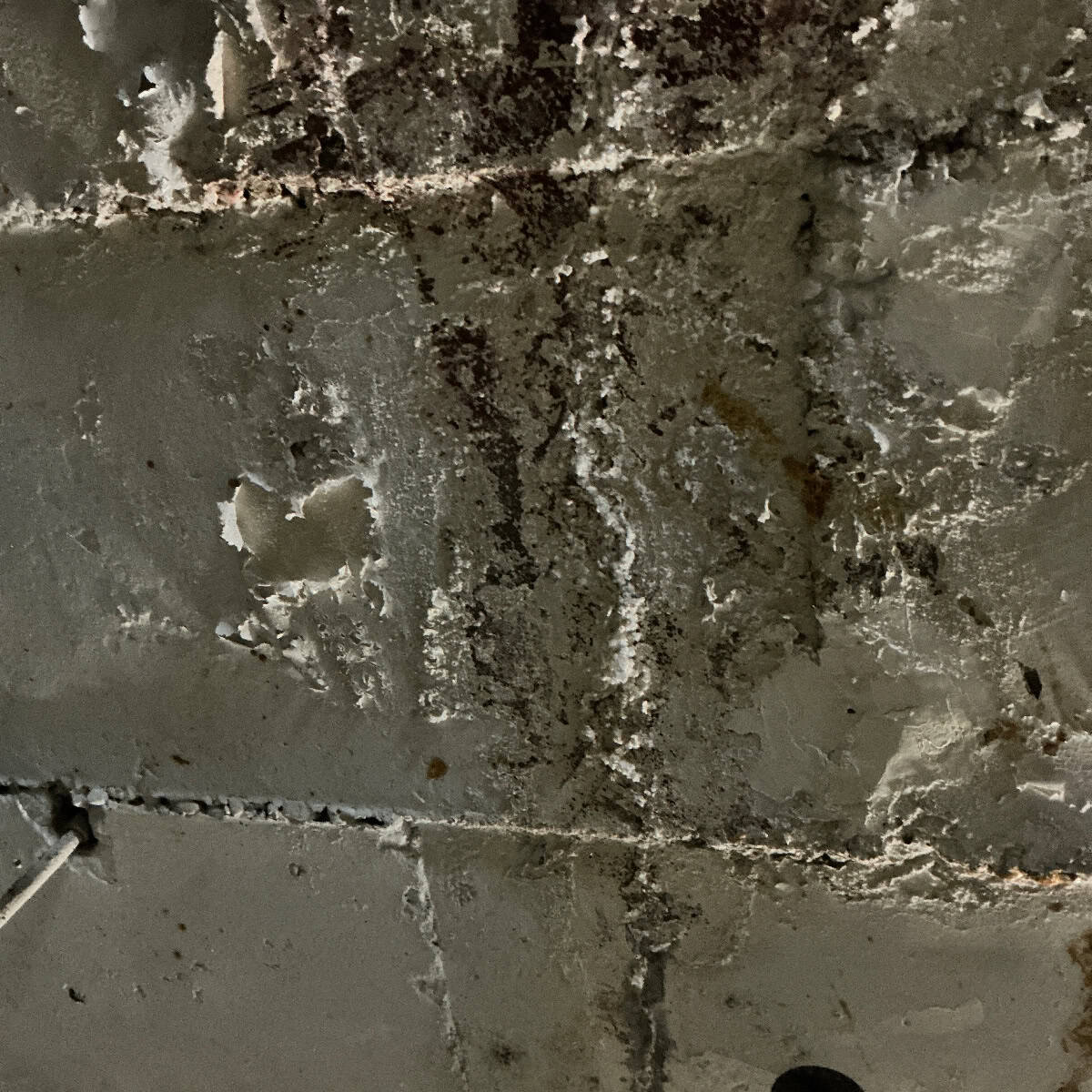
By the time corrosion is visible, it has often been active for years, and the bars may have lost part of their section. The concrete can also hide it. A slab or beam can look sound on the surface while the steel underneath is corroding.
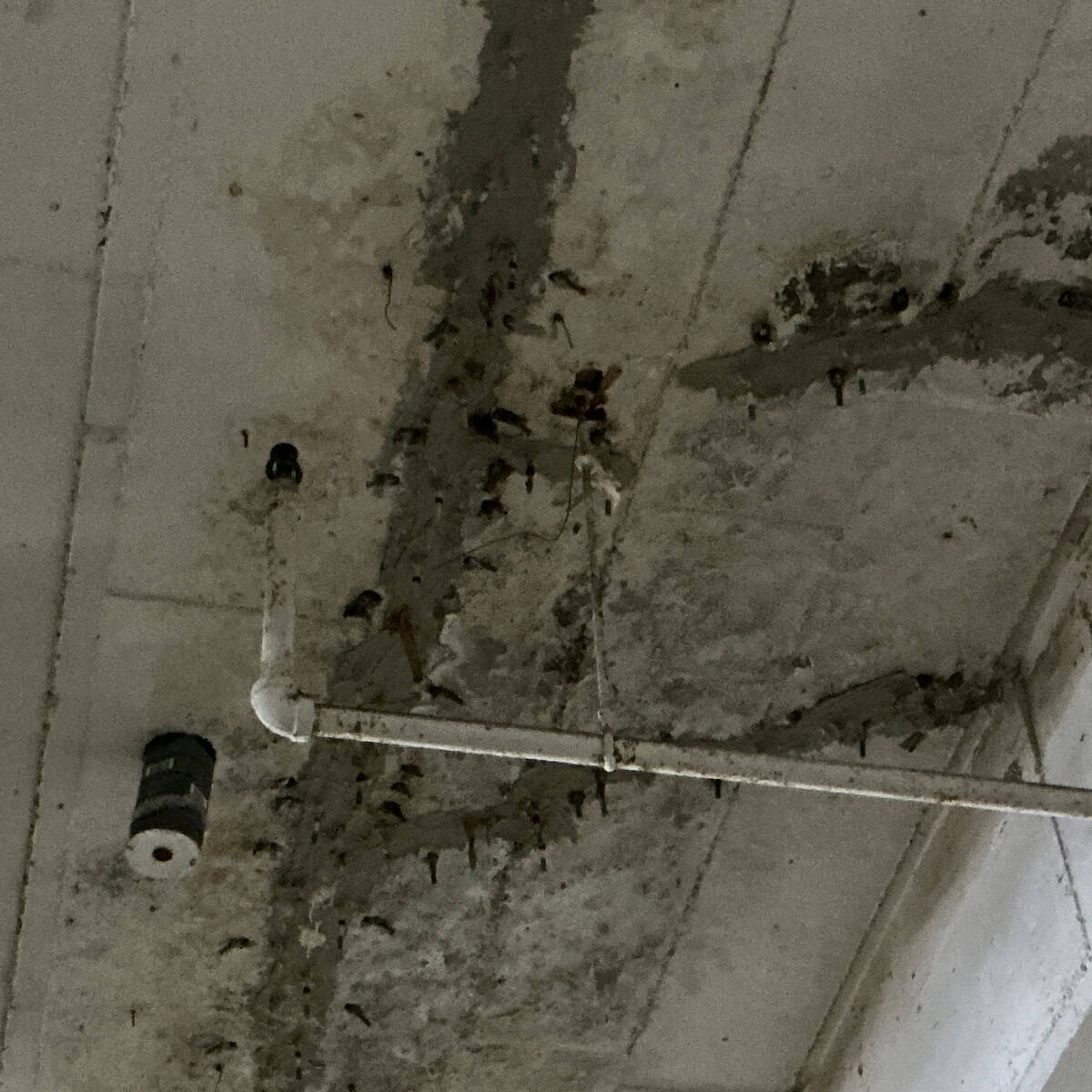
That is why owners and engineers need a way to find corrosion before the concrete shows it. The half-cell potential test does that. It reads the electrical activity of the steel through the concrete and maps the areas where corrosion is likely to be active, so the damage can be found and repaired while it is still small.
What Is a Half-Cell Potential Test?
When steel corrodes, it gives off electrons, and its electrical potential shifts to more negative values. The half-cell potential test reads that activity as a voltage. A reference electrode, called a half-cell, is placed on the concrete surface. A wire connects the reinforcing steel to a high-impedance voltmeter, and the meter reads the potential difference between the steel and the reference electrode.
The most common reference is a copper-copper sulfate electrode (CSE). It is a copper rod sitting in a saturated copper sulfate solution, with a porous tip that touches the wet concrete. Silver-silver chloride electrodes are also used. Their readings are converted to the CSE scale before they are compared.
Here is what the half-cell potential test does and does not tell you:
- What it measures: the corrosion potential of the steel, in millivolts (mV), at each point on a grid.
- What it shows: the likelihood that corrosion is active at the time of testing.
- What it does not show: how fast the steel is corroding or how much section the bars have lost.
- Where it works: uncoated reinforcing steel in concrete that is moist enough to carry current.
When Is the Half-Cell Potential Test Used?
Owners, contractors and engineers call for a half-cell potential test in many situations:
- Condition assessments: mapping corrosion risk across a parking deck, podium slab or balcony before a repair budget is set.
- Repair design: helping the engineer of record decide where to remove concrete, where to patch and where to protect.
- Property purchases and due diligence: giving buyers data on hidden corrosion in older concrete buildings.
- Coastal and marine structures: piers, seawalls and buildings near the ocean, where salt air drives chloride into the concrete.
- Leaks and fire damage: checking reinforcement in areas exposed to long-term water leaks or heat.
- Monitoring: repeating the survey at the same points over the years to see whether corrosion activity is growing or slowing after a repair.
The test is often paired with other methods. ASTM C1152 chloride testing shows how much chloride has reached the steel. GPR scanning maps the rebar and its cover. Exploratory openings let us see the bars and measure section loss. Together, these give the design team a fuller picture than one test alone.
How Is the Half-Cell Potential Test Performed?
ASTM C876 sets out the procedure. A typical half-cell potential test follows these steps:
- Scan and locate the steel. We scan the area with GPR to find the reinforcement, its spacing and cover, and any conduits or tendons in the way.
- Lay out the grid. We mark a measurement grid on the concrete surface. Spacing depends on the element and the size of the area. Older editions of ASTM C876 suggested about 4 ft on bridge decks, with closer spacing where adjacent readings differ by more than 150 mV. Beams, columns and balconies need a tighter grid.
- Make the steel connection. We use an exposed bar or open a small area to reach the reinforcement, then clamp the voltmeter lead to clean steel. Continuity checks between distant bars show whether the steel is connected across the test area. Where it is not, we make more connections.
- Pre-wet the surface. The concrete is wetted with water or a contact solution so the electrode can complete the circuit through the concrete. Readings are taken once they hold steady.
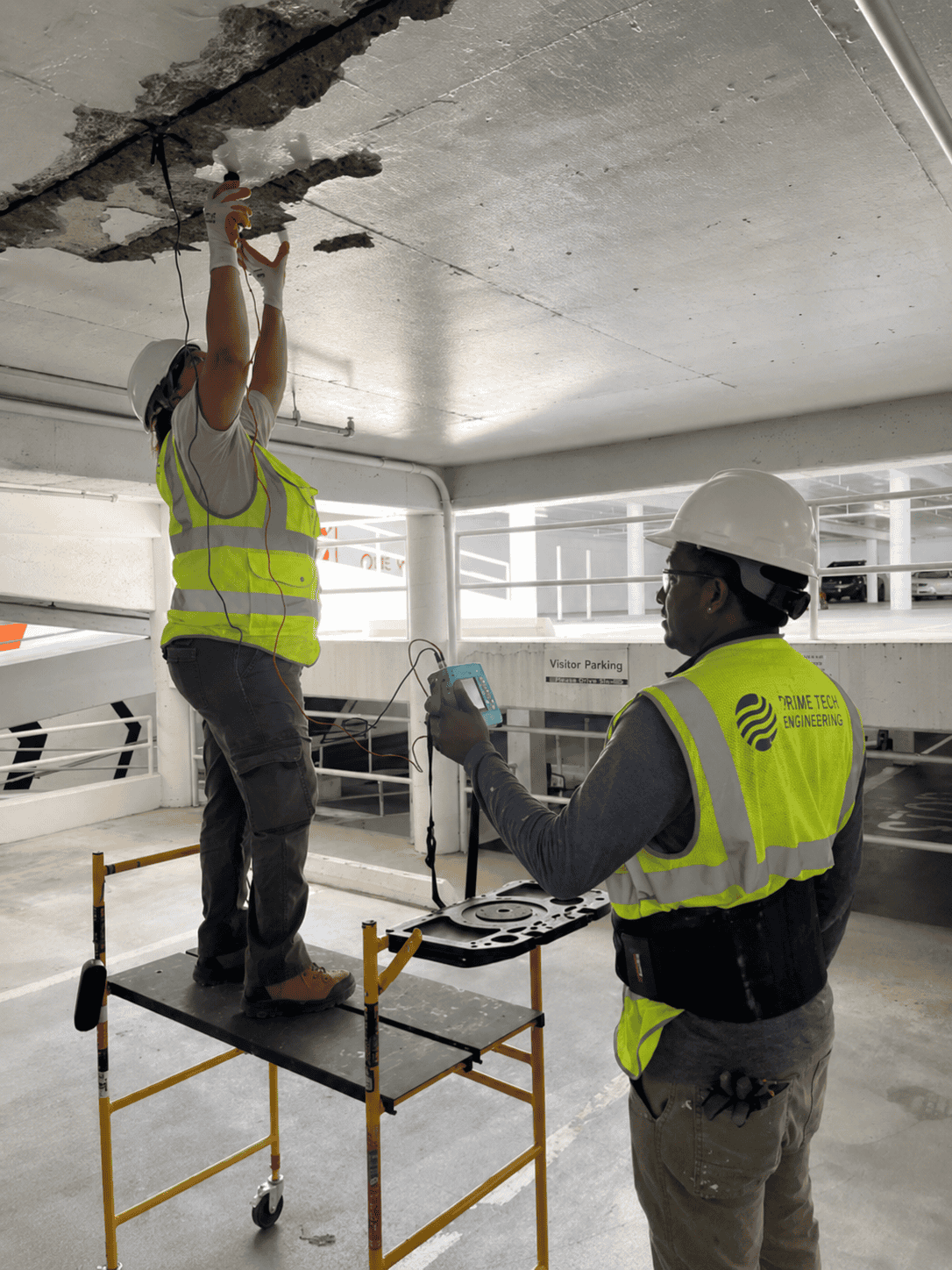
- Take the readings. The technician places the half-cell at each grid point and records the potential. Wheel electrodes are used on large open decks to collect data faster.
- Record site conditions. We note temperature, surface moisture, coatings, cracks, spalls, patches and rust stains, because each of these affects how the readings are read.
- Map and report. The data is plotted as an equipotential contour map, with color bands showing the more negative zones. The report explains what the pattern suggests and where follow-up testing would help.
What Do Half-Cell Potential Test Readings Mean?
Half-cell readings are negative numbers in millivolts. The more negative the reading, the higher the chance that the steel is corroding at that location. ASTM C876 gives a common guideline for copper-copper sulfate readings, and the FHWA summary of the half-cell potential method uses the same ranges:
- More positive than -200 mV: about a 90% probability that no corrosion is active at the time of measurement.
- Between -200 mV and -350 mV: uncertain. Corrosion may or may not be active.
- More negative than -350 mV: about a 90% probability that corrosion is active.
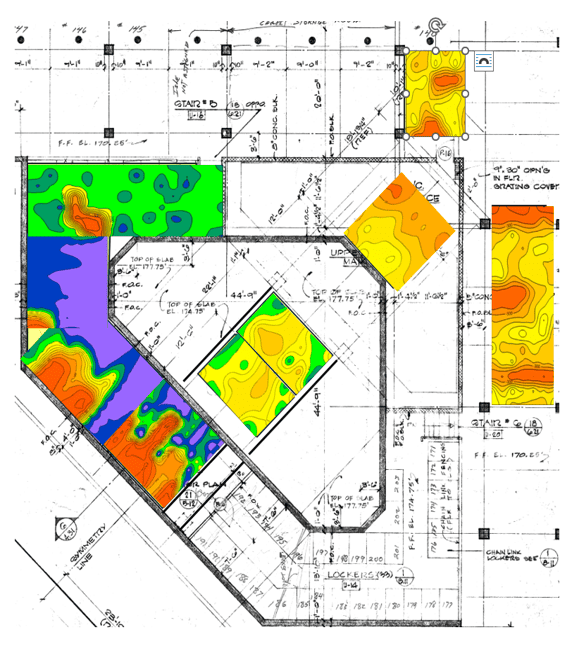
These ranges are a guide, not a verdict. The pattern on the map often tells more than one number. A sharp drop in potential over a short distance, called a steep potential gradient, often points to an active corrosion spot. A large area with uniform readings far below -350 mV can mean something different, such as saturated concrete with little oxygen, where corrosion may be slow.
What Is an Acceptable Half-Cell Potential Reading?
ASTM C876 does not set a pass or fail limit for a structure. The half-cell potential test estimates the probability of corrosion activity at the tested points. Decisions on repair come from the engineer of record, who reviews the half-cell data together with chloride results, cover depth, visual condition and the findings at any openings.
How Do We Check Half-Cell Results With Section Loss Measurements?
A half-cell potential test shows where corrosion is likely. It does not show how much steel has been lost. To answer that, we open the concrete at selected points and look at the bars.
After the half-cell potential test, we pick opening locations with the design team. Most go in the zones with the most negative readings, and a few go in areas with low readings as a control. At each location we do the following:
- Expose the rebar. We chip out the concrete cover to uncover a short length of bar, after GPR scanning to avoid tendons and conduits.
- Clean the bar. Loose rust and scale are removed so the remaining steel can be measured.
- Measure the diameter with calipers. We take readings at the most corroded part of the exposed bar and at a sound part nearby.
- Estimate section loss. The remaining diameter is compared with the nominal bar size, or the best estimate of the original size, and the loss is reported as a percentage of the bar area.
- Photograph and document. We record the bar size, cover, concrete condition, rust type and any pitting at each opening.
The openings check the half-cell potential test results against what is in the concrete. When bars under the most negative readings show rust and section loss, and bars under the low readings are clean, the map can be used with more confidence across the untested areas. When the two disagree, the engineer looks for the reason, such as wet concrete, coatings or a gap in steel continuity.
Section loss measurements apply to the exposed length of the bars that were opened. Steel outside the openings may be in better or worse condition. Once the measurements are done, we patch each opening with cementitious repair mortar.
What Affects Half-Cell Potential Test Results?
Many site conditions shift the readings. Knowing them keeps the data from being misread:
- Moisture: dry concrete has high resistance and can give unstable readings. Saturated concrete can read below -350 mV even where corrosion is slow, because there is little oxygen at the steel.
- Coatings and membranes: traffic coatings, epoxy and some sealers block the circuit. ASTM C876 does not apply where a waterproofing membrane sits between the steel and the surface.
- Epoxy-coated rebar: the standard does not apply to structures with epoxy-coated reinforcement.
- Galvanized steel: zinc coatings change the potential scale, so the standard ranges do not apply.
- Temperature: readings drift with temperature. The standard gives a range around 72°F where the effect can be ignored, and a correction outside that range.
- Cover depth and concrete quality: deep cover and dense concrete can average the readings over several bars.
- Stray currents and cathodic protection: nearby electrical sources or an existing cathodic protection system can affect the numbers.
- Carbonation and surface contamination: a carbonated or contaminated surface layer can shift readings and make them less reliable.
For these reasons, the half-cell potential test should be planned and interpreted by an engineer who knows both corrosion and concrete materials. The current edition, ASTM C876-22b, also notes that other data, such as chloride content and carbonation depth, is often needed to read the results.
Why Is the Half-Cell Potential Test Important?
Corrosion of reinforcement is one of the most common causes of damage in concrete structures. The longer it runs, the more concrete has to be removed, the more steel has to be replaced, and the more the repair costs.
The half-cell potential test finds active corrosion before that damage shows. It helps owners:
- Plan repair budgets with data instead of guesses.
- Target the investigation, so cores, chloride samples and chip-outs go where they will tell the most.
- Limit concrete removal, by separating active zones from areas that are still sound.
- Track repairs over time, by repeating the survey at the same grid points.
- Support safety decisions on balconies, parking structures and overhead concrete.
The same thinking applies to new repairs. Once a repair is in place, a pull-off test checks whether the new material is bonded to the concrete.
Is the Half-Cell Potential Test Destructive?
The half-cell potential test is nondestructive across the surface. The electrode sits on the concrete and leaves no mark. The one intrusive step is the steel connection. Where no bar is exposed, we make a small opening to reach the reinforcement. We patch those openings with a cementitious repair mortar once the work is done. Most surveys need one or a few connection points, depending on whether the steel is continuous through the area.
Half-Cell Potential Test vs. Other Corrosion Tests
The half-cell potential test is one tool in a corrosion assessment. Each method answers a different question:
- Half-cell potential (ASTM C876): where corrosion is likely to be active.
- Chloride ion testing (ASTM C1152 or C1218): how much chloride is in the concrete at the depth of the steel.
- Carbonation depth: whether the protective alkaline zone around the bars has been lost.
- Corrosion rate testing: how fast the steel is corroding at selected points, using methods such as linear polarization resistance.
- GPR scanning: where the bars are and how much cover protects them.
- Shear wave tomography: where there are voids, delaminations or honeycombing inside the concrete. Our post on shear wave tomography (MIRA) explains how it works.
- Exploratory openings: what the bars look like and how much section they have lost.
A typical program uses the half-cell map to find the areas of concern. Chloride samples and openings then go to the most negative zones and to a few control areas. This sequence puts the intrusive work where it will tell the most, and keeps the cost of the investigation down.
7 Essential Facts About the Half-Cell Potential Test
- It estimates probability, not rate. The half-cell potential test shows the likelihood of active corrosion. It does not measure how fast the steel is corroding.
- ASTM C876-22b is the current edition. The standard covers uncoated reinforcing steel in field and lab concrete.
- Below -350 mV is a warning sign. Readings more negative than -350 mV CSE point to a high probability of active corrosion.
- Above -200 mV is a good sign. Readings more positive than -200 mV CSE point to a low probability of corrosion.
- The pattern matters. Gradients and contour shapes on the map often say more than one reading.
- Site conditions change the numbers. Moisture, coatings, temperature and steel type all affect the results.
- Openings check the map. Exposing bars and measuring their diameter with calipers shows how much section has been lost where the readings are most negative.
Frequently Asked Questions
How long does a half-cell potential test take?
Field time depends on the area and the grid spacing. A few balconies or beams can often be tested in one day. A large parking deck may take several days. GPR scanning, connection points and pre-wetting add time. The report follows once the data is mapped and the engineer has reviewed it with the site notes.
Can the half-cell potential test be done on coated concrete?
Not in most cases. Membranes, traffic coatings, epoxy and many sealers break the electrical circuit, so the readings are not reliable. The coating may need to be removed at the test points, or other methods such as chloride testing and openings may be used instead. We review the surface before planning the survey.
Does a reading below -350 mV mean the structure is unsafe?
No. A reading below -350 mV shows a higher chance of active corrosion at that point. It does not measure section loss or structural capacity. The engineer of record uses the half-cell data with chloride results, openings and the visual survey to decide whether repairs are needed and how soon.
How many test points are needed?
It depends on the element and the goal of the survey. Grids on large slabs are wider, while beams, columns and balconies need closer spacing. Where readings jump between points, we add points to define the boundary. The engineer and client agree on the grid before the field work starts.
Can the test be repeated to monitor a repair?
Yes. Repeating the half-cell potential test at the same grid points, under similar moisture and temperature, shows whether corrosion activity is rising or falling. This is useful after repairs, new coatings or cathodic protection are installed. Marking the grid points or saving their coordinates keeps the surveys comparable.
What is the difference between half-cell potential and corrosion rate testing?
The half-cell potential test shows where corrosion is likely to be active across an area. Corrosion rate testing, such as linear polarization resistance, estimates how fast the steel is corroding at a few selected spots. The half-cell map is used to choose where the rate tests should go.
Conclusion
The half-cell potential test gives owners and engineers a map of where rebar corrosion is likely to be active, before cracks and spalls make it visible. Performed under ASTM C876 and read alongside chloride results, GPR scans and exploratory openings, it helps the design team target repairs and plan budgets with data from the structure itself.
Testing before the damage spreads costs less than repairing after concrete starts to fall. If your building has rust stains, cracking along the bars, or a history of leaks or salt exposure, a half-cell potential test is a practical first step.
How Prime Test Engineering Can Help
Prime Test Engineering performs the half-cell potential test as part of our corrosion assessment work for owners, contractors and engineers. We plan the grid with the design team, scan the steel, collect the readings and deliver a report with contour maps, photos and plain notes on what the data suggests.
We also offer the related services that round out a corrosion investigation:
- Corrosion assessment: half-cell mapping, chloride testing and corrosion evaluation for reinforced concrete.
- GPR scanning: locating rebar, tendons and conduits, and measuring cover, before testing, coring or cutting.
- Concrete coring: cores for compressive strength, chloride samples and lab review.
- Concrete testing: field and lab testing of concrete strength and properties.
- Nondestructive testing: shear wave tomography, ultrasonic pulse velocity, rebound hammer, pull-off testing and other NDT methods.
- Structural condition assessment: visual surveys and mapping of cracks, spalls, delaminations and exposed steel for the design team.
- Balcony inspection services: inspections of balconies, decks and other elevated elements.
- Fire damage assessment: testing concrete and reinforcement after a fire.
We combine these tests so the results answer the questions your design team needs answered. To schedule a half-cell potential test or talk through your project, call us or request a quote.
This article is general information about the half-cell potential test and is not engineering advice for a specific structure. Test methods, acceptance values and repair decisions are set by the project specification and the engineer of record.