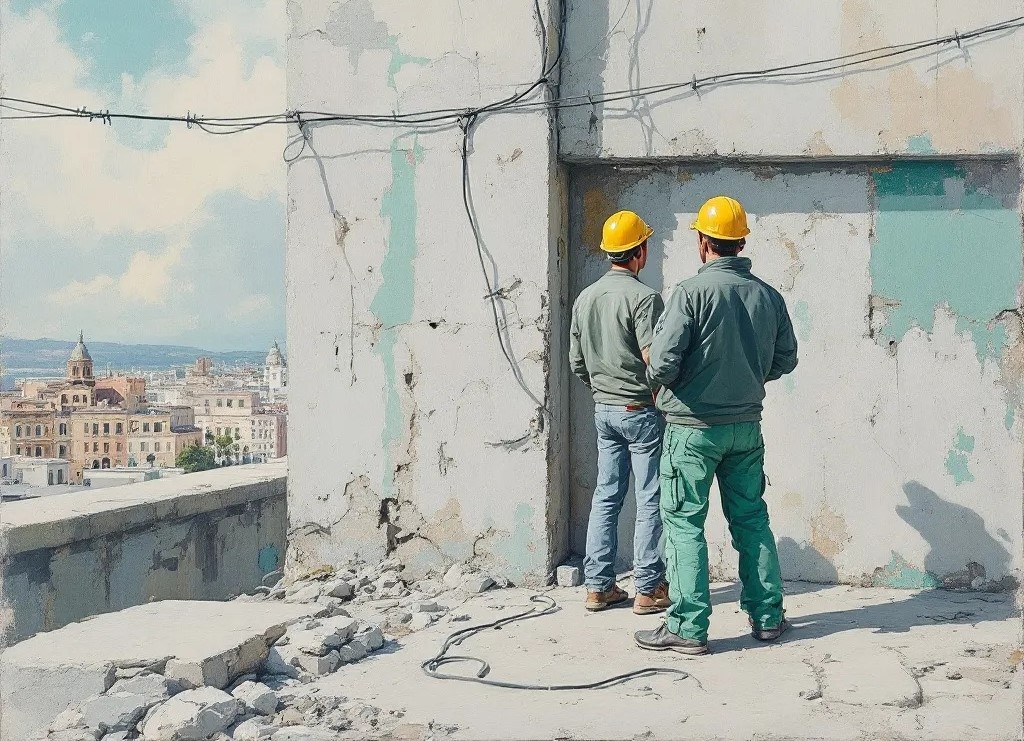

A building doesn’t usually collapse because someone made one big mistake. It collapsed because a dozen small ones went unchecked — a batch of concrete that never hit its design strength, rebar that was quietly substituted with a cheaper grade, soil that couldn’t bear the load anyone assumed it could.
Material testing is the practice that catches those small mistakes before they get poured into a foundation, welded into a frame, or buried under a slab where nobody will see them again until something gives way. The question of how material testing prevents construction failures isn’t abstract engineering theory — it’s the difference between a structure that lasts eighty years and one that makes the evening news.
What Material Testing Actually Means on a Job Site
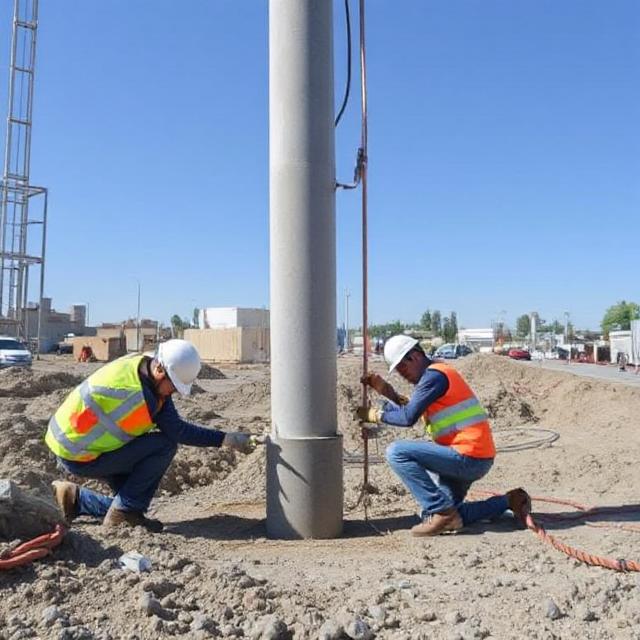
Material testing is the systematic checking of construction inputs — concrete, steel, soil, masonry units, aggregates, timber — against the specifications an engineer designed the structure around. It happens at three points: before construction (testing the soil and raw materials), during construction (testing concrete as it’s poured, checking weld quality as steel goes up), and after key milestones (core testing hardened concrete, load-testing a finished slab).
The tests themselves aren’t glamorous. A slump test for wet concrete takes about ten minutes and a metal cone. A compression test on a concrete cylinder happens in a hydraulic press that costs less than a used car. None of this looks like the kind of high-tech inspection people imagine when they hear “quality control.” But the humble nature of these tests is exactly why they work — they’re fast enough and cheap enough to run on every batch, every day, which means problems get caught at the scale they actually occur: one truckload at a time.
Three Failure Points Material Testing Is Designed to Catch
1. Soil That Can’t Carry the Load
Every structural failure story that starts with “the ground gave way” traces back to a geotechnical report that was either skipped, rushed, or ignored. Soil testing — bore logs, Standard Penetration Test (SPT) values, plate load tests, California Bearing Ratio (CBR) tests for roads — tells an engineer what the ground beneath a site can actually support, and just as importantly, what it can’t.

Clay soils shrink and swell with moisture; a foundation designed without accounting for that will crack as the seasons change. Loose, sandy soil in a seismic zone can liquefy under shaking, turning solid-seeming ground into something closer to quicksand. The 1985 Mexico City earthquake killed thousands of people not because the shaking itself was unusually severe at ground level, but because the lakebed soil under parts of the city amplified the seismic waves at exactly the frequency that resonated with mid-rise buildings — a phenomenon soil testing and site-specific seismic analysis are built to flag in advance. You cannot see this kind of risk by looking at a site. You can only find it by testing what’s underneath it.
2. Concrete That Never Reaches Design Strength
Concrete is deceptive. It looks the same whether it’s going to cure at 40 MPa or 20 MPa — the difference only shows up under load, often years later, often without warning. That’s why compressive strength testing exists: cylindrical or cube samples are taken from the same batch poured into the structure, cured under controlled conditions, and crushed in a testing machine at 7 and 28 days to confirm the mix actually achieves what the design called for.
The slump test, done on-site before a single cylinder is even cast, checks workability — whether the mix has the right water-cement ratio. Too much water and the concrete is easier to pour but weaker once it cures; contractors under time pressure are frequently tempted to add water on-site to speed up placement, and slump testing is the check that catches it in real time, not 28 days later when the cylinders come back from the lab.
Beyond strength, concrete gets tested for durability characteristics that matter over a structure’s lifespan: water-cement ratio, chloride content (critical for structures near seawater, where chloride-induced corrosion of embedded rebar is one of the leading causes of premature structural deterioration), and sulfate resistance for foundations in aggressive soils.
3. Steel That Isn’t What the Mill Certificate Claims
Reinforcement steel is supposed to arrive on-site with a mill test certificate stating its yield strength, tensile strength, and elongation properties — but certificates can be mismatched to shipments, and counterfeit or substandard rebar is a documented problem in fast-growing construction markets. Tensile testing pulls a steel sample until it yields and eventually fractures, confirming the actual yield strength (commonly Fe 415, Fe 500, or Fe 550 grade rebar in Indian construction, denoting yield strength in MPa) matches what the structural design assumed.
This matters more than it sounds like it should. A structural engineer designs a column or beam around a specific steel yield strength; if the actual steel on-site yields 15% below spec, the member’s actual safety margin shrinks by roughly the same proportion — and that’s before accounting for cyclic loading, wind, or seismic demand the design was supposed to have margin against. Bend tests and rebend tests additionally check ductility — whether the steel can deform without snapping, which is exactly what you want it to do in an earthquake rather than fracturing suddenly.
Where Testing Failures Have Become Structural Failures
The Rana Plaza collapse in Dhaka, Bangladesh, in April 2013, killed over 1,100 garment workers. Investigations afterward pointed to a building constructed with substandard materials and expanded with additional floors the original design and foundation were never tested or certified to carry — heavy vibrating generators and machinery added load the structure had never been verified against. It’s a stark example of what happens when material and structural verification is treated as a formality rather than a control.

Closer to a purely material-driven failure, the 2021 partial collapse of the Champlain Towers South condominium in Surfside, Florida, killed 98 people. While the full investigation by the National Institute of Standards and Technology (NIST) is still ongoing as of the most recent public updates, early findings pointed toward long-term concrete deterioration and corrosion of embedded reinforcement — exactly the kind of slow-building material failure that periodic testing and structural condition assessments are designed to catch before it becomes irreversible. I’ll flag this clearly: the final NIST report with definitive root-cause conclusions had not been released as of the latest confirmed public updates, so treat this as an ongoing investigation rather than closed case history.
These aren’t outliers. They’re the visible tip of a much larger pattern where routine material verification — the boring, procedural stuff — turns out to have been the only thing standing between “structure” and “disaster.”
The Standards That Govern Testing (And Why They Exist)
Material testing isn’t improvised on a job site — it follows codified standards designed by engineers who have studied exactly how materials fail. In India, the Bureau of Indian Standards (BIS) governs this through codes like IS 456 (plain and reinforced concrete), IS 1786 (specification for high-strength deformed steel bars), and IS 2720 (methods of test for soils, published in multiple parts covering everything from moisture content to shear strength). Internationally, ASTM International standards (like ASTM C39 for concrete compressive strength) and Eurocodes serve the same function.
These standards specify not just what to test, but how often, at what sample size, and under what statistical acceptance criteria. A single low concrete cylinder result doesn’t automatically fail a batch — codes define acceptable variation ranges because material properties naturally vary slightly from batch to batch. What the standards prevent is the human tendency to treat one bad result as a fluke and move on without investigating whether it’s actually a pattern.
What Genuine, Rigorous Testing Looks Like in Practice
Testing that actually prevents failures — as opposed to testing that exists on paper to satisfy a checklist — has a few consistent features. Samples are taken by an independent party or at minimum a third-party-witnessed process, not exclusively by the contractor whose schedule and budget benefit from passing results. Testing labs are NABL-accredited (National Accreditation Board for Testing and Calibration Laboratories, in the Indian context) or hold equivalent international accreditation, meaning their equipment calibration and procedures are independently audited. Results are documented and retained, not just verbally reported, so that a pattern of marginal results across multiple batches is visible to someone reviewing the project later rather than buried in individual pass/fail slips.
Genuine testing programs also don’t stop at compliance minimums. A structural engineer overseeing a hospital or a high-rise will often specify tighter acceptance criteria and more frequent sampling than the legal minimum requires, precisely because the cost of a single failed test is trivial compared to the cost of a failure discovered after occupancy.
Common Tests and What They’re Actually Checking
| Material | Test | What It Catches |
| Concrete (fresh) | Slump test | Excess water, poor workability, inconsistent mix |
| Concrete (hardened) | Compressive strength (cube/cylinder) | Whether the batch reaches design strength (e.g., M25, M30 grade) |
| Concrete | Chloride and sulfate content | Long-term corrosion and durability risk |
| Steel reinforcement | Tensile test | Actual yield and ultimate strength vs. mill certificate |
| Steel reinforcement | Bend/rebend test | Ductility — resistance to sudden, brittle failure |
| Soil | Standard Penetration Test (SPT) | Bearing capacity, liquefaction risk |
| Soil | California Bearing Ratio (CBR) | Suitability for road and pavement subgrade |
| Masonry units | Compressive strength, water absorption | Load capacity, weathering resistance |
The Cost Argument, Stated Plainly
A full concrete testing regime for a mid-sized residential project typically adds a fraction of a percent to total construction cost — often cited in industry practice as somewhere in the range of 0.5% to 1% of the materials budget, though this varies by project scale and local lab rates and should be confirmed against actual local quotations rather than treated as a fixed number. Compare that to the cost of demolishing and rebuilding a structural element after occupancy, the legal liability of a failure that injures someone, or the reputational cost to a builder whose name is now attached to a collapse. The math isn’t close. Testing is cheap insurance against a catastrophically expensive failure mode, and the only parties who consistently argue otherwise are the ones trying to cut corners on a fixed-price contract.
What This Means If You’re Commissioning Construction
If you’re a homeowner, a developer, or someone overseeing a construction project rather than an engineer running the tests yourself, there are a few concrete things worth asking your contractor or consultant for: copies of soil test reports before foundation design is finalized, concrete cube test results at 7 and 28 days for each pour (not just a final summary), and mill certificates cross-checked against independent tensile test results for any structurally significant steel delivery. Ask which lab performed the testing and whether it’s accredited. None of this is adversarial — a contractor running a genuinely rigorous quality program will have these documents ready and will usually be glad to share them, because it’s the paper trail that protects them too if a dispute ever arises later.
Material testing doesn’t make headlines when it works, because a building that doesn’t collapse is not a story. It only becomes visible in its absence — in the investigation reports written after something has already gone wrong. That asymmetry is exactly why it’s worth insisting on before the concrete is poured, not after the cracks appear.
Conclusion
Material testing is one of the simplest and most cost-effective ways to prevent construction failures before they become expensive or dangerous problems. By verifying soil capacity, concrete strength, steel quality, and other critical properties at each stage of construction, testing gives engineers and builders evidence that the structure is being built to the design it was approved for.
The real value isn’t in passing a test or ticking a compliance box. It’s in catching a weak concrete batch, unsuitable soil, or substandard steel while there’s still time to fix it. For anyone commissioning or managing construction, properly documented testing from accredited laboratories should be treated as a core safety measure, not an optional expense. A few hours and a small testing cost upfront can prevent years of structural problems — and, in the worst case, save lives.