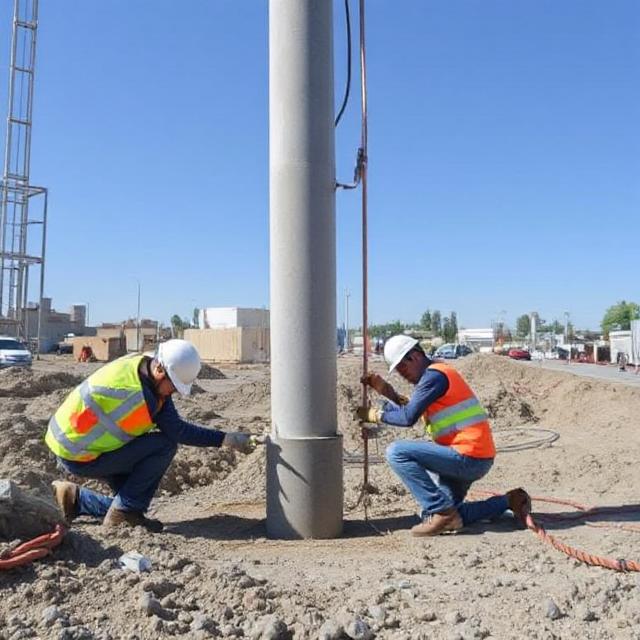


The quality and integrity of concrete are critical to the safety and longevity of buildings,bridges, parking structures, and other infrastructure. While visual inspections canidentify surface deterioration, many internal defects remain hidden. Ultrasonic Pulse Velocity (UPV) Testing is a proven Non-Destructive Testing (NDT) method that evaluates the internal condition and uniformity of concrete without causing damage. At PrimeTest Engineering, we perform UPV testing throughout California to help engineers assessconcrete quality, identify internal defects, and support structural evaluations.
Concrete can contain hidden defects that are not visible from the surface. Honey combing, voids, poor consolidation, internal cracking, and freeze-thaw damage may reduce structural performance while remaining concealed beneath intact concrete.
Ultrasonic Pulse Velocity (UPV) Testing allows engineers to evaluate concrete quality by measuring how quickly ultrasonic waves travel through the material. Areas containing sound, dense concrete generally transmit ultrasonic waves faster than areas containing defects or deterioration.
UPV is widely used during structural investigations because it provides valuable information without damaging the structure.
Typical applications include:
- Parking structures
- Commercial buildings
- Bridges
- Foundations
- Concrete walls
- Columns and beams
- Industrial facilities
- Water treatment structures
What Is Ultrasonic Pulse Velocity (UPV) Testing?
Ultrasonic Pulse Velocity (UPV) Testing is a non-destructive method used to evaluate the quality and uniformity of concrete by transmitting high-frequency sound waves through the structure.
A transmitting transducer sends an ultrasonic pulse into the concrete while a receiving transducer records the arrival time. The travel time is then used to calculate the pulse velocity.
Generally:
- Higher pulse velocities indicate dense, uniform concrete.
- Lower pulse velocities may indicate cracking, voids, honeycombing, poor consolidation, or deteriorated concrete.
UPV evaluates the overall condition of the concrete matrix but does not directly measure compressive strength.
How Does UPV Testing Work?
The testing procedure is quick, non-invasive, and suitable for both new and existing structures.
 Step 1 – Select Testing Locations
Engineers identify representative areas based on structural drawings, visual observations, or previous investigations.
 Step 2 – Prepare the Surface
The concrete surface is cleaned, and a coupling gel is applied to improve transmission of ultrasonic waves.
 Step 3 – Transmit Ultrasonic Waves
A transmitting transducer sends ultrasonic pulses through the concrete while a receiving transducer measures the travel time.
Step 4 – Calculate Pulse Velocity
The equipment calculates pulse velocity using the measured distance and travel time.
Step 5 – Engineering Interpretation
Engineers compare measurements across multiple locations to identify areas exhibiting reduced concrete quality or potential internal defects.
What Can UPV Testing Detect?
Ultrasonic Pulse Velocity Testing can help identify a variety of internal concrete conditions, including:
- Honeycombing
- Internal cracking
- Voids
- Poor concrete consolidation
- Areas of deteriorated concrete
- Freeze-thaw damage
- Fire-related concrete degradation
- Variations in concrete quality
- Differences between repair materials and existing concrete
UPV is particularly useful for comparing concrete quality across different portions of a structure and identifying areas that may require additional investigation.
Benefits of Ultrasonic Pulse Velocity Testing
UPV offers several advantages over traditional destructive testing methods.
Key benefits are:
- Completely non-destructive
- Rapid field testing
- Immediate results
- Evaluates internal concrete quality
- Detects hidden defects
- Large-area coverage
- Reduces unnecessary concrete coring
- Supports repair planning
- Cost-effective investigation method
Because no concrete is removed during testing, structures typically remain in service while evaluations are performed.
When Should UPV Testing Be Used?
UPV Testing is recommended whenever engineers need to evaluate concrete quality without damaging the structure.
Common applications include:
- Condition assessments of aging buildings
- Parking garage investigations
- Bridge inspections
- Fire damage evaluations
- Concrete repair investigations
- Seismic retrofit projects
- Quality assessments after concrete placement
- Historic structure evaluations
- Structural rehabilitation projects
UPV is also valuable for identifying representative locations for concrete coring and laboratory testing. However, keep in mind that UPV needs access from both sides.
Combining UPV with Other NDT Methods
Ultrasonic Pulse Velocity Testing is most effective when integrated with other investigation techniques.
Prime Test Engineering frequently combines UPV with:
- Ground Penetrating Radar (GPR) for locating reinforcing steel and embedded utilities
- Half-Cell Potential Testing for evaluating reinforcing steel corrosion
- Chain Drag Surveys for detecting delamination
- Impact Echo Testing for identifying internal voids and estimating slab thickness
- Concrete Coring for laboratory compressive strength testing
- Petrographic Analysis
- Visual Condition Assessments
Using multiple NDT methods provides engineers with a more comprehensive understanding of structural conditions and improves confidence in repair recommendations.
How Prime Test Engineering Can Help
Prime Test Engineering provides Ultrasonic Pulse Velocity Testing and comprehensive Non-Destructive Testing services for reinforced concrete structures throughout California.
Our services include:
- Ultrasonic Pulse Velocity (UPV) Testing
- Ground Penetrating Radar (GPR)Half-Cell Potential Testing
- Impact Echo Testing
- Chain Drag Surveys
- Concrete Coring
- Petrographic Analysis
- Chloride and Carbonation Testing
- Structural Condition Assessments
- Engineering Reports and Repair Recommendations
Our engineers combine field testing, laboratory analysis, and structural engineering expertise to provide accurate evaluations that support maintenance planning, repair design, and long-term asset management.
Conclusion
Ultrasonic Pulse Velocity Testing is an effective non-destructive method for evaluating concrete quality and identifying hidden internal defects without causing damage to the structure. By measuring the speed of ultrasonic waves through concrete, engineers can assess uniformity, detect areas of deterioration, and determine where additional investigation may be necessary.
When combined with complementary NDT methods and engineering expertise, UPV Testing provides valuable information for structural investigations, repair planning, and infrastructure management.
Get a Quote
If you need to evaluate the condition of a commercial building, parking structure, bridge, or other reinforced concrete structure, Prime Test Engineering is ready to help.
Contact Prime Test Engineering today to schedule Ultrasonic Pulse Velocity (UPV) Testing anywhere in California.
👉 Visit: https://primetesteng.com/