
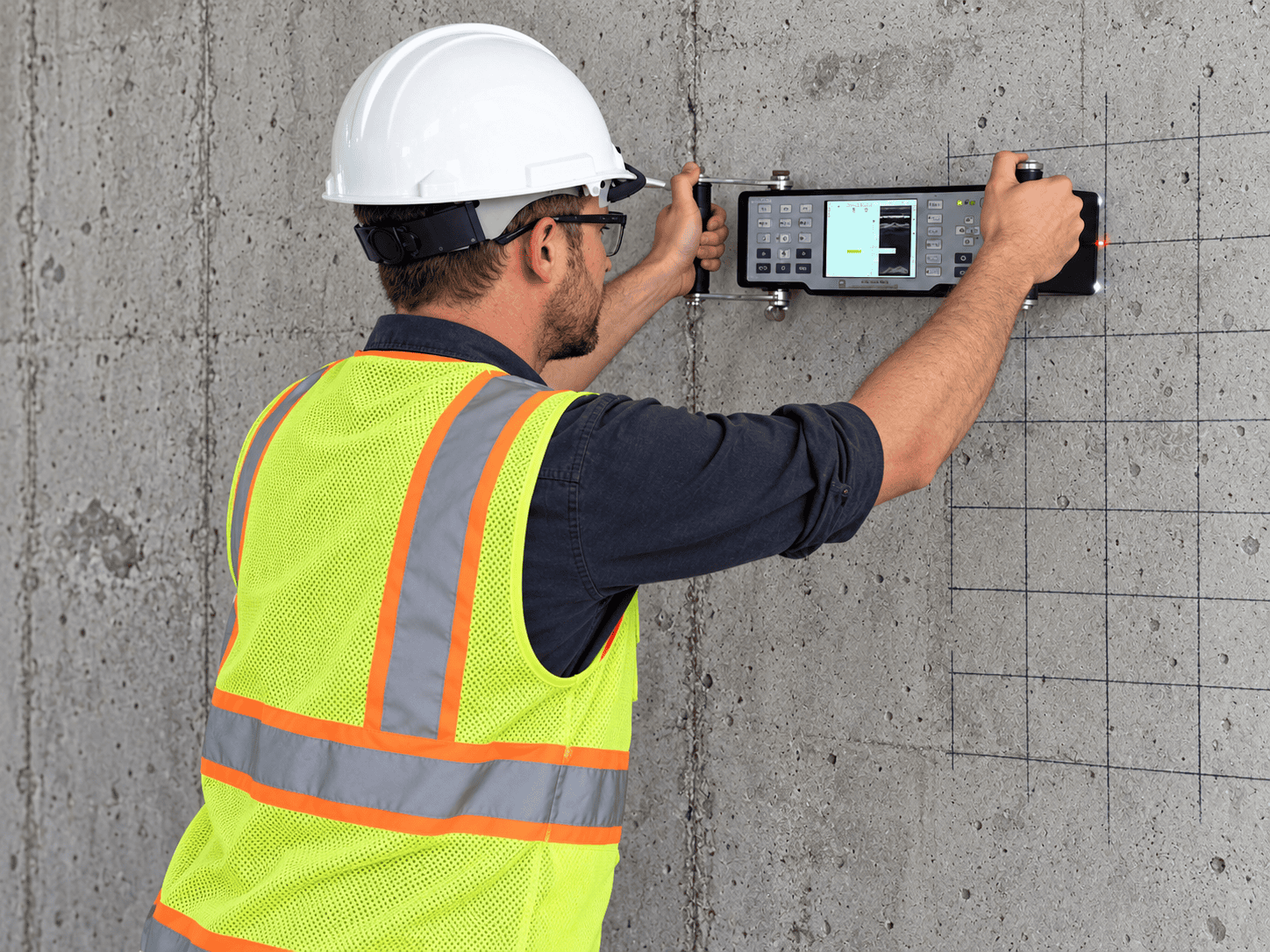
The shear wave tomography method, often performed with a MIRA ultrasonic tomograph, lets engineers look inside concrete without cutting or coring it. It produces cross-section images of a slab, wall, beam, or deck that can show internal voids, delamination, honeycombing, embedded items, and the thickness of the element.
At Prime Test Engineering, we use shear wave tomography as part of our non-destructive testing services to investigate concrete where problems are hidden below the surface. It helps owners and engineers find what is wrong, where it is, and how far it extends, so that any coring or repair can be targeted rather than guessed. Like every NDT method, it has limits, and important findings may still need to be verified.
What Is Shear Wave Tomography?
Shear wave tomography is an ultrasonic pulse-echo method. The device sends low-frequency shear waves (a type of sound wave) into the concrete and records the echoes that bounce back from internal boundaries, such as the back surface of the slab, a void, a crack, or a reinforcing bar.
Instead of a single sensor, the instrument uses an array of many transducers at once. Software then combines all of the recorded signals into an image, using a process called the synthetic aperture focusing technique (SAFT). The result is similar to an ultrasound scan in medicine: a picture of what lies beneath the surface, built from echoes.
How Does a MIRA Tomograph Work?
A MIRA unit is a handheld device fitted with a grid of spring-loaded, dry-contact transducers. The test is carried out in a few steps:
- Plan the scan area. A grid is laid out over the area of concern, with spacing chosen to suit the element size and the defects being investigated.
- Check settings on known areas. The technician first tests locations with known conditions, such as a sound area of known thickness, to confirm the wave velocity and instrument settings.
- Collect the data. The unit is pressed against the concrete at each grid point. One row of transducers transmits while the others receive, and the process repeats until every row has transmitted. No gel or couplant is needed.
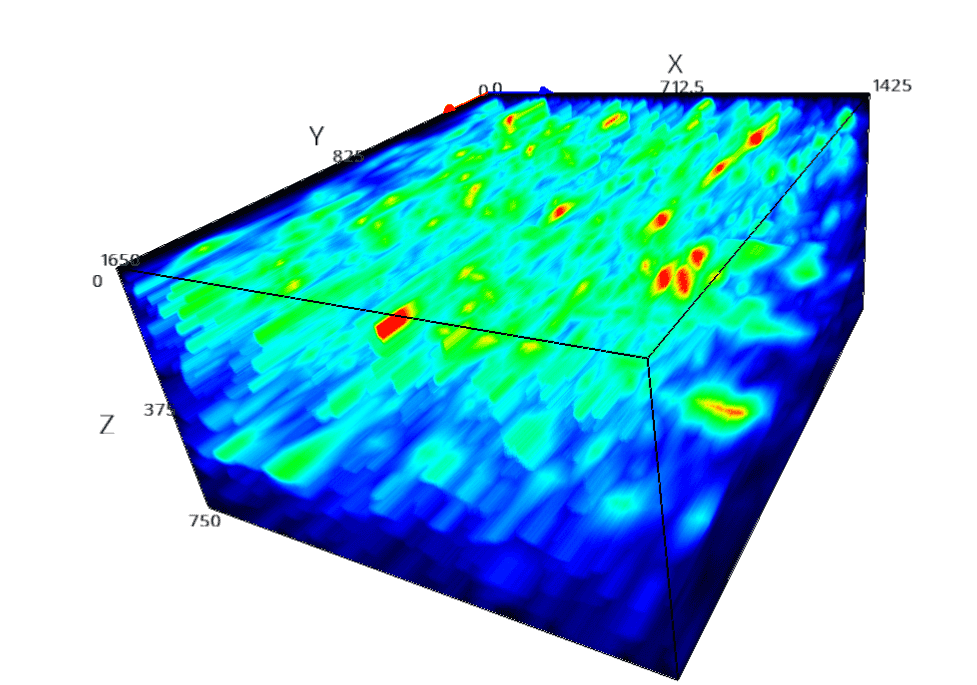
- Build the images. Software reconstructs the data into cross-sections and plan-view slices at different depths, and can combine them into a 3D view of the scanned area.
- Interpret the results. An engineer reviews the images, compares them with drawings and other test results, and marks areas that may need verification.
How Are the Scan Results Displayed?
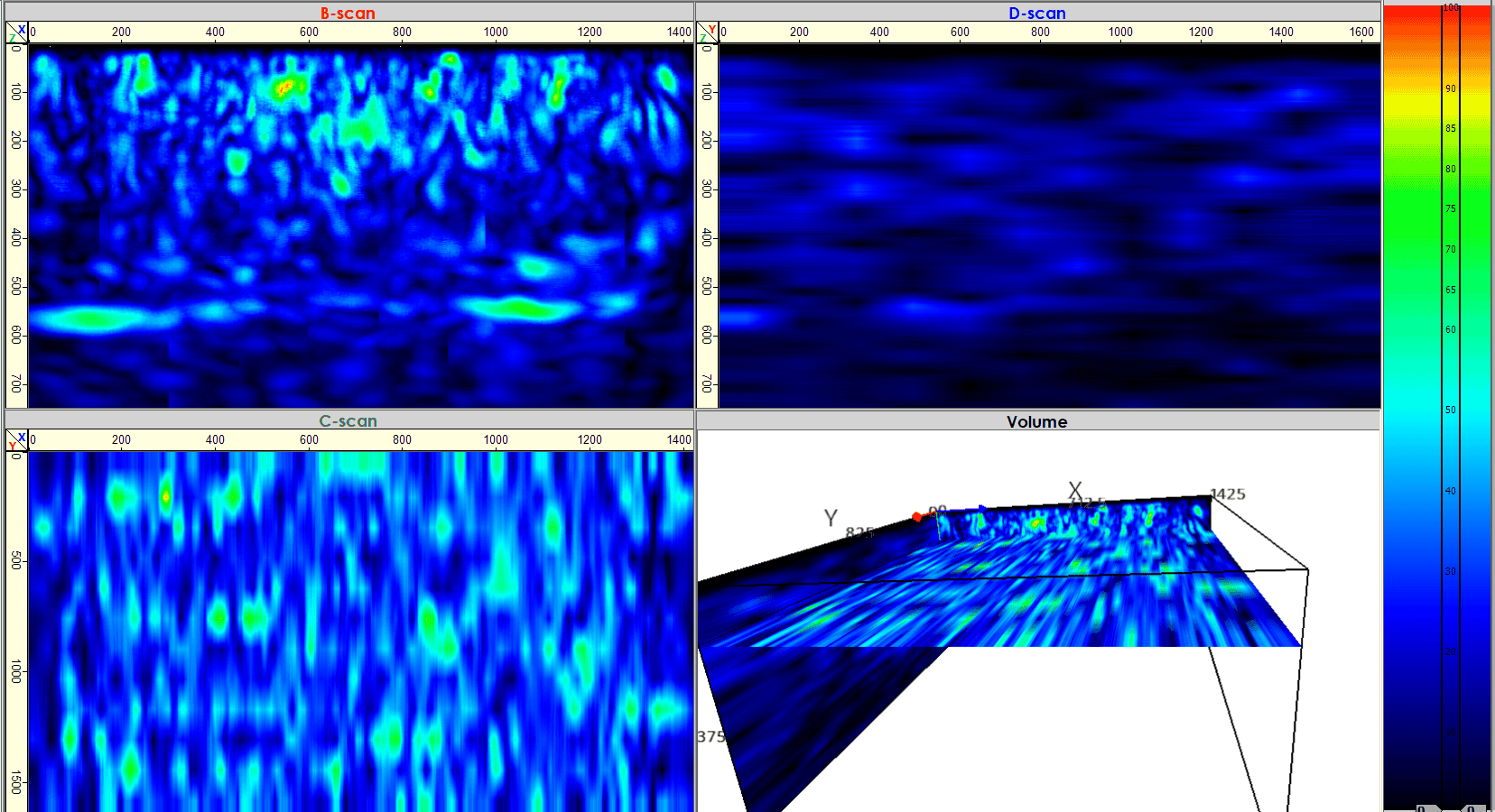
The software shows the same data in several views. A B-scan is a vertical cross-section along the scan line, a D-scan is a vertical cross-section across it, and a C-scan is a plan-view slice at a chosen depth. Brighter colors indicate stronger reflections, which may point to a boundary, an embedded item, or a defect. Together with the 3D volume view, these help engineers judge the location, depth, and extent of each feature.
Call Us: (310) 205-2535 Get a Quote
What Can Shear Wave Tomography Detect in Concrete?
Depending on site conditions, shear wave tomography can help identify:
- Element thickness: the depth of slabs, walls, and decks, measured from one side only.
- Voids and honeycombing: areas of poor consolidation or missing concrete inside the element.
- Delamination: horizontal cracks or separations, often caused by rebar corrosion.
- Embedded items: reinforcing steel, post-tension tendons, ducts, and conduits.
- Grout defects: possible voids in grouted post-tension ducts.
- Repair and overlay layers: possible debonding between an overlay and the original concrete.
Can It Tell an Air Void From a Water-Filled Void?
Not reliably. Both produce a strong reflection, and the images alone usually cannot tell them apart. Where this matters, engineers confirm with targeted coring or other investigation.
What Are the Limitations of Shear Wave Tomography?
Shear wave tomography is a powerful tool, but it is not a perfect picture of the inside of a structure:
- It cannot see past an air gap. A large void or delamination reflects nearly all of the wave, so little or no information is available from deeper below it.
- Dense reinforcement can mask features. Closely spaced or multiple layers of rebar can make deeper features harder to detect.
- Surface contact matters. Very rough, coated, or damaged surfaces can reduce signal quality.
- It takes time. Grid-based scanning is slower than GPR, so it is usually focused on areas of concern rather than entire floors.
- Interpretation requires experience. The images are reconstructions, not photographs. Their accuracy depends on correct settings and engineering judgment.
Shear Wave Tomography vs. GPR vs. Impact Echo
| Method | Best used for | Key limitation |
|---|---|---|
| Shear wave tomography (MIRA) | Imaging internal voids, honeycombing, delamination, and thickness in cross-section | Slower coverage; cannot see past large air gaps |
| Ground penetrating radar (GPR) | Fast mapping of rebar, tendons, and conduits over large areas | Less direct for small voids and honeycombing; affected by moisture and dense steel |
| Impact echo | Thickness and flaw checks at individual points | Point-by-point results; no cross-section image |
| Ultrasonic pulse velocity (UPV) | Overall concrete quality and uniformity between two faces | Usually needs access to both sides; gives an average along the path |
Why Combine Methods?
Each method sees the concrete differently. A common approach is to map reinforcement and suspect areas quickly with GPR scanning, investigate those areas in detail with shear wave tomography, and then confirm key findings with a small number of concrete cores. This gives more reliable answers with less damage to the structure.
Call Us: (310) 205-2535 Get a Quote
When Is Shear Wave Tomography Used?
Common applications include:
- Checking new concrete for voids or honeycombing behind congested reinforcement.
- Investigating delamination in parking structures, bridge decks, and podium slabs.
- Measuring slab and wall thickness when only one side is accessible.
- Locating post-tension tendons and checking grouted ducts for voids.
- Evaluating concrete before renovation, coring, or repair design.
- Assessing concrete after a fire as part of a fire damage assessment.
Shear Wave Tomography at Prime Test Engineering
Prime Test Engineering provides shear wave tomography and other non-destructive testing services throughout Southern California. Depending on the project, an investigation may include visual observations, GPR scanning, grid-based tomography scans, anomaly mapping, thickness measurements, and recommendations for targeted verification, with results reviewed by a licensed professional engineer.
Learn more about our non-destructive testing services and concrete coring services. You can also read our guides to detecting voids beneath concrete slabs and concrete delamination testing.
Frequently Asked Questions
Is shear wave tomography destructive?
No. The transducers rest on the concrete surface, and no drilling, cutting, or coring is needed to collect the data.
Do I need access to both sides of the concrete?
No. Shear wave tomography is a pulse-echo method, so it works from one side. This makes it useful for slabs on grade, walls against soil, and decks.
How deep can shear wave tomography see?
It depends on the concrete, reinforcement, and the features present. In sound concrete it can measure the full thickness of typical slabs and walls, but it cannot see beyond a large air gap such as a delamination.
Is MIRA the same as GPR?
No. GPR uses electromagnetic waves and is very good at locating steel. Shear wave tomography uses ultrasonic stress waves and is better suited to imaging voids, honeycombing, and delamination in the concrete itself.
Can shear wave tomography find voids under a slab?
It mainly images the concrete element itself. A gap beneath a slab may show up as a change in the back-wall reflection, but other methods, such as GPR or targeted openings, are usually needed to evaluate subslab voids.
How long does a scan take?
It depends on the size of the area and the grid spacing. Detailed scans are usually focused on specific areas of concern rather than entire buildings.
Conclusion
Shear wave tomography gives engineers a way to see inside concrete without cutting it. By imaging voids, honeycombing, delamination, embedded items, and thickness from one side, it helps target repairs and reduce the number of cores needed. Its results require careful interpretation, and key findings may need direct verification.
Contact Prime Test Engineering to discuss shear wave tomography for your building, parking structure, or concrete investigation.
Call Us: (310) 205-2535 Get a Quote